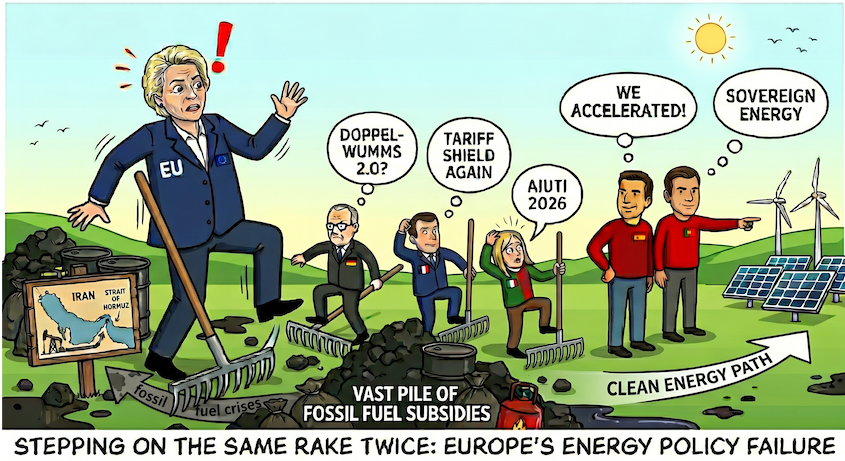
Last weekend, as spring was in full swing, the Green Libertarian was over at his brother's house performing his customary gardening duties. The task of the day involved sifting through leaves, rocks, and sand, so he arranged the various tools needed for the job in a careful semicircle around the pile he was working on. Unfortunately, as he walked back and forth with a shovel, he failed to notice that he had left the rake casually propped up against the retaining wall, tines pointing skyward in the manner of a small but very patient mantrap.
"Scheisse," he exclaimed, with the particular cadence reserved for the moment a wooden handle bangs against the forehead. Thankfully, the bump was small. But the lesson was clear: put the damn rake away, lest you step on it again.
Unfortunately, over in Europe, national governments and Brussels are currently demonstrating the opposite, as the EU is getting slammed again in the forehead by the metaphorical rake of a fossil-fueled energy crisis. The second one in less than 5 years.
The €24 Billion Bump (and Counting)
As the Iran war rages on with no sign of abatement, Europeans are once again paying for their continent's dependence on imported fossil fuels. Just like they did after Putin's disastrous invasion of Ukraine back in the winter of 2022.
In the nearly two months since the US-Israeli strikes on Iran and its closure of the Strait of Hormuz in response, the EU has spent an additional €24 billion on energy imports because of higher prices. That is more than $587 million per day. The Commission's own description of what Europe got in return for that money is admirably blunt: not a single extra molecule of energy.1
Brent crude is above $105 a barrel. Lufthansa has cut 20,000 flights through October because jet fuel costs have doubled. In ports from Galilee to Pula, fishermen are tying up their boats because diesel makes the trip unprofitable; Croatian skippers report that fuel now eats up to 70 percent of their earnings.2 Fertiliser plants have shut down, which has knocked on to CO2 shortages, which in turn has affected food and healthcare supply chains. The UK had to restart a mothballed bioethanol plant just to keep hospitals supplied with medical-grade carbon dioxide.
How is it that Europe has found itself in this situation once again? The short answer is that the policy response to the Ukraine war energy crisis treated the symptom, not the disease. The longer answer requires a closer look at where €540 billion went.
What €540 Billion Actually Bought
The 2022 energy crisis, triggered by Russia's invasion of Ukraine, cost European governments approximately €540 billion in subsidies and price relief over 2022 and 2023.3 Half a trillion euros, transferred from European taxpayers to fossil fuel importers, in the name of shielding consumers from the prices that would have jolted the same consumers into recognising it was time to insulate their homes, install heat pumps, and stop driving diesel SUVs through Munich.
The national breakdown tells the story better than the aggregate.
Germany. In September 2022, Chancellor Olaf Scholz announced the Doppel-Wumms (the "double whammy"), a relief package authorised at up to €200 billion. Despite the name that should have stayed in a comic caption and not used for serious policy, the €200 billion singalled the intention of just how much the SPD-led government was willing to waste on subsidising fossil fuel consumptions. To put that figure in perspective: in 2024, German transmission system operators (TSOs) invested €16.5 billion and distribution system operators (DSOs) invested €8.9 billion in the country's electricity grid, for a combined total of €25.4 billion. The Doppel-Wumms authorisation was therefore roughly eight years of total German grid investment at 2024 levels, written in a single weekend of cabinet meetings in September 2022. The signal markets rely on to drive behavioural change, "energy is now expensive, conserve it," was muted. And the money that could have cleared the permitting backlog for already-planned wind and solar projects, or fast-tracked the long-overdue North-South high-voltage direct current (HVDC) corridors, was earmarked instead for cushioning gas bills.4
The centrepiece was a gas price brake that capped consumer prices below the market rate. The full €200 billion was never actually spent, because gas prices fell faster than expected. But the authorisation is what matters: it tells you exactly how the German government saw the problem. As a temporary price spike to be papered over with public money, not as a structural signal that the country needed to electrify, insulate, and decouple from fossil gas at speed.
France. The bouclier tarifaire ("tariff shield") capped electricity and gas price increases for households at 4 percent in 2022 and 15 percent in 2023, while the actual market increase would have been roughly 35 to 45 percent. Total cost over 2022 to 2024, according to the Cour des Comptes, was €72 billion, or 2.6 percent of GDP.5 EDF (Électricité de France), the state-owned utility, was forced to sell electricity below cost via the Accès Régulé à l'Électricité Nucléaire Historique (ARENH) mechanism, which obliged it to sell a fixed share of its nuclear output to competitors at a regulated price well below the wholesale market. EDF absorbed roughly €8 billion in losses that the French taxpayer is still paying down through the company's recapitalisation.
Italy. Across a sequence of decrees nicknamed Aiuti, Aiuti-bis, Aiuti-ter, and Aiuti-quater, Italy spent roughly €90 billion on energy support in 2022 and 2023. The ones who were aiutati (helped) were the fossil fuel exporters. The country that arguably needed the deepest structural reform spent some of the most on price relief. The disconnect between symptom and disease was particularly stark.
Iberia. Spain and Portugal took a different approach. In June 2022, after pushing Brussels for permission, they introduced what became known as the "Iberian exception", a cap on the price of fossil gas used for electricity generation. Cost: roughly €8.5 billion across the two countries. The mechanism is worth a closer look because it explains why this was the cleverest crisis intervention in Europe. In a typical EU electricity market, the merit-order rule means the most expensive plant called on in a given hour sets the wholesale price for everyone else. Most of the time in Italy, that plant is a fossil gas turbine, which means Title Transfer Facility (TTF) gas prices, the Dutch wholesale benchmark used across continental Europe, flow directly through into electricity bills. The Iberian exception broke that link by reimbursing gas-fired plants the difference between TTF and a capped reference price, only for the gas they actually burnt to make power. Consumer gas use was not subsidised. The price signal at the meter remained intact. What was capped was the marginal price-setter, which is exactly the lever that matters. It bought time while the structural transition continued, and it cost Iberia an order of magnitude less than what France or Germany spent on blanket consumer relief.
Add up Germany, France, Italy, every other EU member state, plus the UK, and you get to roughly €540 billion. Most of it spent subsidising the consumption of the very fuels whose price was the problem. Consumption stayed high, the cheques went out, and four years later Europe is still importing roughly the same amount of fossil energy. And here is the most bitter irony of all. Despite the outright condemnation of Putin's war and the show of verbal support for Ukraine, a meaningful share of that €540 billion ended up in Moscow's coffers. Europe had not entirely stopped the import of Russian oil and gas; now, with higher prices brought about by Russia itself, the EU taxpayer was effectively financing Putin's war machine. The same war machine whose cruise missiles were levelling Ukrainian apartment blocks. Ukrainians are Europeans. The continent's response to the worst land war on European soil since 1945 was to send the aggressor extra money for fuel, which the aggressor then used to kill more European civilians. This is what fossil-fuel dependence looks like when geopolitics turns sour. A more elegant own goal is hard to imagine.
The response to the Ukraine war energy crisis was the largest exercise in subsidising the wrong behaviour in modern European economic history. All the while fuelling the pockets of Europe's strategic nemesis to boot! Let's hope that a bitter lesson was learnt so that the same mistake is not made again four years later as the Iran war rages on.
Same Playbook, New Branding
So how is Brussels responding to energy crisis numéro deux? With a 44-action plan called AccelerateEU, announced on 22 April 2026.6
The plan deserves a closer reading than the press release allows, because it contains both genuinely good ideas and one rake-shaped policy provision sitting near the top of the document.
The good. AccelerateEU sets an electrification target lifting electricity's share of EU final energy consumption from roughly 23 percent today to 32 percent by 2030. It expands the Industrial Decarbonisation Bank to €100 billion, including a €30 billion ETS Investment Booster financed by 400 million ETS allowances. It pushes the European Grids Package, the Energy Highways projects, and faster permitting for repowering existing sites. Textbook market-friendly measures: price the externality, fund the infrastructure, let capital flow.
The probably useless. The plan creates a "Fuel Observatory" to track production, imports, exports, and stock levels of transport fuels. Whenever Brussels announces an Observatory, you can usually assume that nobody could agree on a binding measure, so they agreed on a body to observe the problem instead. Useful telemetry, possibly. A substitute for action, definitely. As expected of Brussels as a dish of moules-frites washed down with a Leffe Tripel.
The rake. Buried in the same document is the bit that gives the game away: the Commission will relax state-aid rules to let member states "implement targeted, temporary emergency measures." Translation from Brussels-speak: capitals are once again free to write large cheques to subsidise the consumption of the very fuels whose price is the problem. Windfall taxes on energy companies? Optional, at national discretion, with no EU-wide framework. The Commission has handed national governments back the same rake that hit them in the forehead in 2022, with a cheerful "do try not to step on it again."
In Germany, the debate is already on. The Saxony-Anhalt premier and parts of the Free Democrats have called for a fuel tax break, the so-called Tankrabatt, the same measure introduced in 2022 that economists at the time told the government was a transfer to oil majors. The CDU-CSU-SPD coalition took the bait. The Bundesrat, in a special session on 24 April, approved a two-month cut to diesel and petrol taxes of 14.04 cents per litre net, or roughly 17 cents gross with VAT, starting 1 May 2026. Same playbook – same rake.7 Leading German economists are now telling the government the same thing they told it in 2022. We will see whether anyone listens the second time around.
Why this Crisis Hurts Less, and Why Europe Should Not Celebrate
The bad reason: Europe's energy-intensive industry is already gutted from the 2022 crisis. You cannot have a demand shock when the demand has already left for the United States or for China, or has simply ceased to exist. The €24 billion bill of crisis number two is being paid by what is left of the industrial base, plus a long list of households and small businesses that have nowhere to relocate to. Slovenia became the first EU country to introduce fuel rationing on 23 March, capping private motorists at 50 litres per day.8 Fuel protests broke out in Ireland on 7 April. UK supermarket chains have warned of forecourt shortages. The casualty list of round two is shorter than that of round one, mostly because round one already removed the heaviest casualties from the field.
The good reason is that, despite all the headwinds in an uncertain global geopolitical environment, European wind and solar capacity has exploded since 2022. In 2025 (full year), renewables provided 48 percent of EU electricity generation, more than any other source, and wind and solar together overtook fossil fuels for the first time in EU history.9 The EU-27 added wind capacity from roughly 205 GW at the end of 2022 to about 236 GW by the end of 2025, a steady rather than spectacular increase weighed down by permitting and grid bottlenecks. Solar is the more dramatic story: cumulative EU-27 solar PV roughly doubled, from around 209 GW at the end of 2022 to close to 400 GW by the end of 2025.10 Solar generation grew by more than a fifth in 2025 alone, the fourth consecutive year of double-digit growth. In hours when the Iberian sun shines or the North Sea blows, fossil gas now sets the price for fewer and fewer hours of the year.
The savings are not theoretical. A report by Positive Money published on 24 April found that the build-out of renewable generation made wholesale electricity 24.2 percent cheaper on average across nineteen European countries between 2023 and 2025, and projected total savings as high as €67.5 billion in 2026 if gas prices remain elevated.16 SolarPower Europe calculates that solar alone has saved Europe more than €100 million per day since 1 March, totalling over €3 billion in the first weeks of the Iran war. Spain, which has doubled its wind and solar capacity since 2019 (+40 GW, more than any EU country except Germany, whose power market is twice the size), now sees its wholesale price largely insulated from gas prices, even though those spiked 55 percent the day after the Iran war started. The countries that built out renewables aggressively are collecting their dividend in lower bills. The countries that wrote consumer subsidy cheques in 2022 are paying the second-round bill at TTF prices today.
And here is the part that should make every market-sceptical climate activist uncomfortable: that build-out happened not because of European policy but largely in spite of it. The proximate cause was the high fossil gas prices of 2022 to 2024, which made wind and solar irresistibly attractive on a pure cost basis. Markets did what markets do. Capital flowed to where returns were highest. The directive-writers in Brussels mostly ran behind, trying to take credit for what high TTF prices had already accomplished.
The 2022 price shock did more to accelerate the European energy transition than two decades of Brussels directives. Pain teaches faster than policy. Which is precisely the lesson Europe is once again refusing to learn. Subsidising consumption of expensive fossil fuels is a band aid that, in the long run, only delays the transition and prolongs the pain. Once again, the rake hits the forehead.
A Tale of Two Peninsulas
If you want to see the difference half a decade of structural choices makes, compare the Iberian Peninsula with the Italian one. In the first half of 2025, wholesale electricity prices in Spain were 32 percent lower than the EU average.11 Day-ahead Iberian prices typically run €60-70 per MWh; recent Italian day-ahead prices have ranged €120-150 per MWh, sometimes higher.12 Same continent, same merit-order rules, same Emissions Trading System, wildly different outcomes. Iberia built renewables fast enough to push fossil gas off the marginal price-setting role for a growing share of hours; Italy stayed hooked on imported LNG (Liquified Natural* Gas), some of it Qatari, some of it routed through the now reliably 100 percent open (as claimed by a certain prolific tweeter) Strait of Hormuz. This comparison deserves its own article. It is coming. The lesson for the EU as a whole is straightforward: if every member state had spent the last five years doing more of what Iberia did and less of what Italy did, the war in Iran would be a manageable inconvenience rather than a €24-billion-and-counting transfer to oil and gas exporters.
The Green Libertarian Prescription
Three things, in order of priority.
Stop subsidising consumption. Every euro spent capping prices at the pump or the meter is a euro not spent on a heat pump, a panel, or a transmission line. To protect vulnerable households, use income-targeted cash transfers, not a blanket subsidy of fossil fuel consumption. Subsidising a German banker's petrol bill is not energy policy. The Iberian exception of 2022 worked because it was narrow, time-limited, and targeted at the marginal price-setting mechanism rather than at consumer behaviour. Copy that. Do not copy the Doppel-Wumms.
Price the externality, then step back. The ETS carbon price averaged around €75 per tonne of CO2 in 2025, up 15 percent year on year.13 It works. The €30 billion ETS Investment Booster announced under AccelerateEU is the right idea: recycle polluter revenues into decarbonisation infrastructure, redistribute the rest to households as carbon dividends, and stop picking technology winners from Brussels. The market already knows the cheapest electron in Europe is a Spanish solar electron. Let it act.
Build the grid. Italy curtails 2 to 4 TWh of renewables per year because the wires are not there. Germany spends €3 to €4 billion annually on redispatch. The renewables exist; the infrastructure to use them does not. Cross-border interconnection, long-term planning, and eminent domain for transmission corridors are the few areas where a coordinated EU role is genuinely justified, because no member state has the incentive to build wires that mainly benefit its neighbours. Build the European Grids Package. Build the Bay of Biscay interconnector. Build the Bornholm Energy Island. Stop debating. The investment need is roughly €1.2 trillion in transmission and distribution by 2040, and every year of delay shows up as a higher TTF spike when the next shock arrives.
Sovereignty Runs on Electrons
Five months ago, in this blog's Energiewende piece, I argued that Germany had spent €520 billion on a clean energy transition and ended up still burning coal because the policy framework prioritised technology mandates over market structure.
Italy is making a smaller-scale version of the same mistake. The Meloni government's energy strategy doubles down on new fossil gas import infrastructure, expanded LNG regasification at Rovigo and Piombino, and pipeline expansions from Algeria and Azerbaijan, while permitting times for onshore wind still run seven to ten years. France is making a different version, one in which EDF is asked to be simultaneously a national champion, a price-suppression instrument, a nuclear renaissance vehicle, and a profitable company. The result is a balance sheet the French taxpayer keeps recapitalising and a European Pressurised Reactor (EPR) programme (Flamanville, Hinkley Point C, the proposed new fleet) whose costs and timelines have become a recurring national embarrassment. The Iberian Peninsula, by contrast, has actually let market forces do their job, and it shows up in the daily wholesale electricity price.
In December's piece on the AI race, I argued that cheap, abundant electricity is the foundation of industrial competitiveness, and that Washington was handing China the future by suffocating clean energy. The same logic applies inside Europe. The countries with cheap, clean, abundant electrons will host the next generation of data centres, electrified industry, and decent middle-class jobs. The countries still writing cheques to Qatari LNG exporters and US shale gas producers will not.
And while Europe was busy writing those cheques, Beijing was reading from a different lesson book. The 2022 shock confirmed for China what its planners had been saying since the 2010s: dependence on Middle East oil and gas is a strategic vulnerability, full stop. The response was not a price brake; it was an investment programme. China spent $625 billion on clean energy in 2024 alone, roughly 31 percent of the global total.14 That is $100 billion more than Germany spent on its Energiewende misadventure.
China installed 430 GW of renewables in 2025, and as of February 2026 its clean electricity capacity exceeded its fossil fuel capacity for the first time. Clean tech contributed close to 10 percent of Chinese GDP in 2024, around $1.9 trillion, growing three times faster than the wider economy.
Brussels would prefer not to confront the geopolitical implication of these numbers. China is the world's largest oil importer and a meaningful share still comes through the Strait of Hormuz. But every additional gigawatt of wind, every rooftop solar array, every electric vehicle on a Beijing street is a small permanent reduction in that exposure. The Iran war hurts China too, just much less than it would have five years ago, because five years of deployment have rotated the energy base away from the chokepoints. As Patrick Xue put it recently in the East Asia Forum, the sun does not require freedom of navigation.15 Beijing internalised that point a decade ago, and became the superpower of cleantech in the process. China stands to benefit the most from this latest round of fossil-fuelled armed conflict; Europe stands to lose. Again.
European energy independence will not be delivered by the orange clown circus in Washington, or by the ayatollahs in Tehran, or indeed by the next round of diplomatic conferences in Paris. It will not be delivered by waiting for Beijing to slow down. It will be brought about by a transformational electricity system whose marginal price is set by wind and sun. Neither can be blockaded. Neither requires a strait to be open. Neither needs the cooperation of governments hostile to European interests.
Spain and Portugal show that this is not a utopian fantasy. It is current operational reality, today, on the Iberian wholesale market. The rest of the EU still gets to choose which example to follow.
The rake is right there on the lawn. Brussels has stepped on it four years ago with diastorous consequences. Today Europe is again at the crossroads. Follow the path of failed policy path and step on the rake of fossil fuel subsidies once again? Or accelerate clean energy deployemnt and avoid the crash of fossil fuel dependence on its forehead? For the sake of the 450 million EU citizens, let's hope that the second time is the charm.
Sources
- European Commission press release IP/26/629, EU AccelerateEU strategy: response to the Iran energy crisis, 22 April 2026; CNN Business, EU has spent €24 billion extra on energy since Iran war began, 22 April 2026.
- ABC News (AP wire), Croatian fishermen feel the strain after Iran war ramps up fuel prices, 7 April 2026; WBUR, Skyrocketing fuel prices squeeze Rhode Island fishermen, 2 April 2026.
- European Environmental Bureau briefing on AccelerateEU, citing European Commission figures, 22 April 2026.
- Center on Global Energy Policy, Columbia SIPA, Understanding Germany's Gas Price Brake: Balancing Fast Relief and Complex Policy Choices, on the €200 billion September 2022 protective shield. For grid investment, see Bundesnetzagentur, Monitoring Report 2025: TSO investment €16.51 billion in 2024; DSO investment €8.91 billion in 2024; both planned higher investment in 2025.
- Cour des comptes via vie-publique.fr, total cost of the bouclier tarifaire 2022-2024.
- Carbon Brief, Iran war: EU strategy sets out 44 actions to limit fossil fuel price shocks, 23 April 2026.
- Bundesregierung, Relief measures for the economy and population, decision of the Bundesrat in special session, 24 April 2026, lowering energy taxes on diesel and petrol by 14.04 cents per litre net (approximately 17 cents per litre gross including VAT) for two months starting 1 May 2026. See also Clean Energy Wire, German Tankrabatt debate revisited, 6 March 2026.
- Wikipedia, 2026 Iran war fuel crisis, section on Slovenia rationing (23 March 2026) and Ireland fuel protests (7 April 2026).
- Ember, European Electricity Review 2026, January 2026.
- SolarPower Europe, Total EU-27 Solar PV capacity: a growth story; WindEurope, Latest wind energy data for Europe, autumn 2025; Strategic Energy Europe, Europe adds 19 GW of wind in 2025, February 2026.
- Ember, Decoupled: how Spain cut the link between gas and power prices using renewables, October 2025.
- IEEFA via World Pipelines, Europe's electricity prices are still tied to gas, making geopolitics a structural vulnerability, April 2026.
- IEA, Electricity 2026, January 2026.
- Ember, China Energy Transition Review 2025, September 2025.
- Patrick Xue, China's renewable capacity is a security asset, not a liability, East Asia Forum, 6 April 2026.
- Positive Money, report on renewable energy and wholesale electricity prices in nineteen European countries, April 2026 (24.2 percent average price reduction 2023-2025; up to €67.5 billion projected savings in 2026), as reported by Euronews, Decoupling from fossil fuel shocks: Europe's electricity made 25% cheaper thanks to solar and wind, 24 April 2026. Daily savings figure (€100 million/day, >€3 billion total since 1 March): SolarPower Europe analysis cited in the same Euronews piece. Spanish 2019-2025 capacity addition (>40 GW): Euronews, same article.