
1. Introduction: The Race
Picture this. A stadium full of people witnessing an epic race. After a slow start, two competitors pull ahead of the field. The one ahead seems to have all the momentum. She has the best running shoes, the latest tracksuit, and the best preparation. Meanwhile, her closest competitor started the race with beat-up shoes and was held back at the starting blocks.
Yet, after a few laps around the racetrack, the leader decides to intentionally throw out her state-of-the-art racing shoes and put on heavy, worn-out work boots. Meanwhile, her competitor is closing in fast, while putting on new, carbon-plated racing shoes with every lap she runs. She has not caught up to the leader yet, but the way things are going, it is only a matter of time.
Okay, maybe the analogy is far-fetched, but the race is very much real. And it just might be the most important race of the 21st century.
As you might have guessed, our self-sabotaging leader is the United States, and hot on her heels is China. It would be no exaggeration to say that the country that wins this particular competition will set the course of humanity in the 21st century and beyond.
2. Why This Race Matters
What race am I talking about?
The race for dominance in the development of Artificial Intelligence. To the uninitiated, this might sound like hyperbolic tech-bro enthusiasm. But the people who understand this technology best are not shy about its significance. Eric Schmidt, the former CEO of Google and former Chair of the National Security Commission on Artificial Intelligence, put it in a staggering historical context: "The arrival of non-human intelligence, AI intelligence, is at the level of electricity or the invention of fire, transportation, etc. in human history. We are fortunate to be living in a time of great historical consequence. The next 10 years are probably the 10 years that will have a greater determination over the next hundred years than anything before."
Demis Hassabis, the neuroscientist and video game designer who founded Google DeepMind, believes "it'll be 10 times bigger than the Industrial Revolution, and maybe 10 times faster." Hassabis expects something that can reasonably be described as Artificial General Intelligence "within the next five to ten years, possibly sooner."
Whether you find such proclamations exciting or terrifying, the geopolitical implications are clear. If AI is the lever that moves the world, everyone wants their hand on it. So, who is the winner? For now, the United States maintains a narrow lead. American companies built the foundational models like GPT-4 and Claude. American chips from Nvidia and AMD power the training runs. American talent developed the architectures. But that lead is shrinking fast.
Jensen Huang, the leather-jacketed CEO of Nvidia, made headlines in November 2025 when he declared bluntly: "China is going to win the AI race." He later softened this to say China is "nanoseconds behind" the US, but his core point stood.
Professor Graham Allison of the Harvard Kennedy School has a sobering assessment: "China stands today as a full-spectrum peer competitor of the United States in commercial and national security applications of AI. Beijing is not just trying to master AI, it is succeeding." On the current trajectory, he believes, "while the United States will maintain a narrow lead over the next five years, China will then catch up and pass us quickly thereafter."
The Belfer Center puts the intellectual foundation in stark terms: "China is graduating three times as many computer scientists as the United States...The blunt truth is that China is laying the intellectual groundwork for a generational advantage in AI." The race is on. The stakes could not be higher. And the US is making a critical, self-inflicted error.
3. The Path to Dominance: Chips and Power
To understand how the United States is sabotaging itself, one needs to understand what AI development actually requires.
Two things matter above all else: chips and power. Electric power, to be clear. The chips are the raw ingredients. Graphics Processing Units (GPUs), originally designed to render video game graphics, turned out to be extraordinarily good at the parallel mathematical operations that neural networks require. Nvidia's latest chips, like the H100 and its successors, are the picks and shovels of the AI gold rush. These are not standard computer chips; they are massive, complex engines of calculation, costing upwards of $30,000 per unit.
But chips alone are just infinitesimally small pieces of metal etched into glass. They need electricity, vast quantities of it, to perform the calculations that train AI models. To give you an idea of the scale, a single large language model training run can consume as much electricity as a city of 130,000 people consumes in a day. We are talking about Cambridge, England, or Berkeley, California, powering nothing but a bank of computers for 24 hours straight.
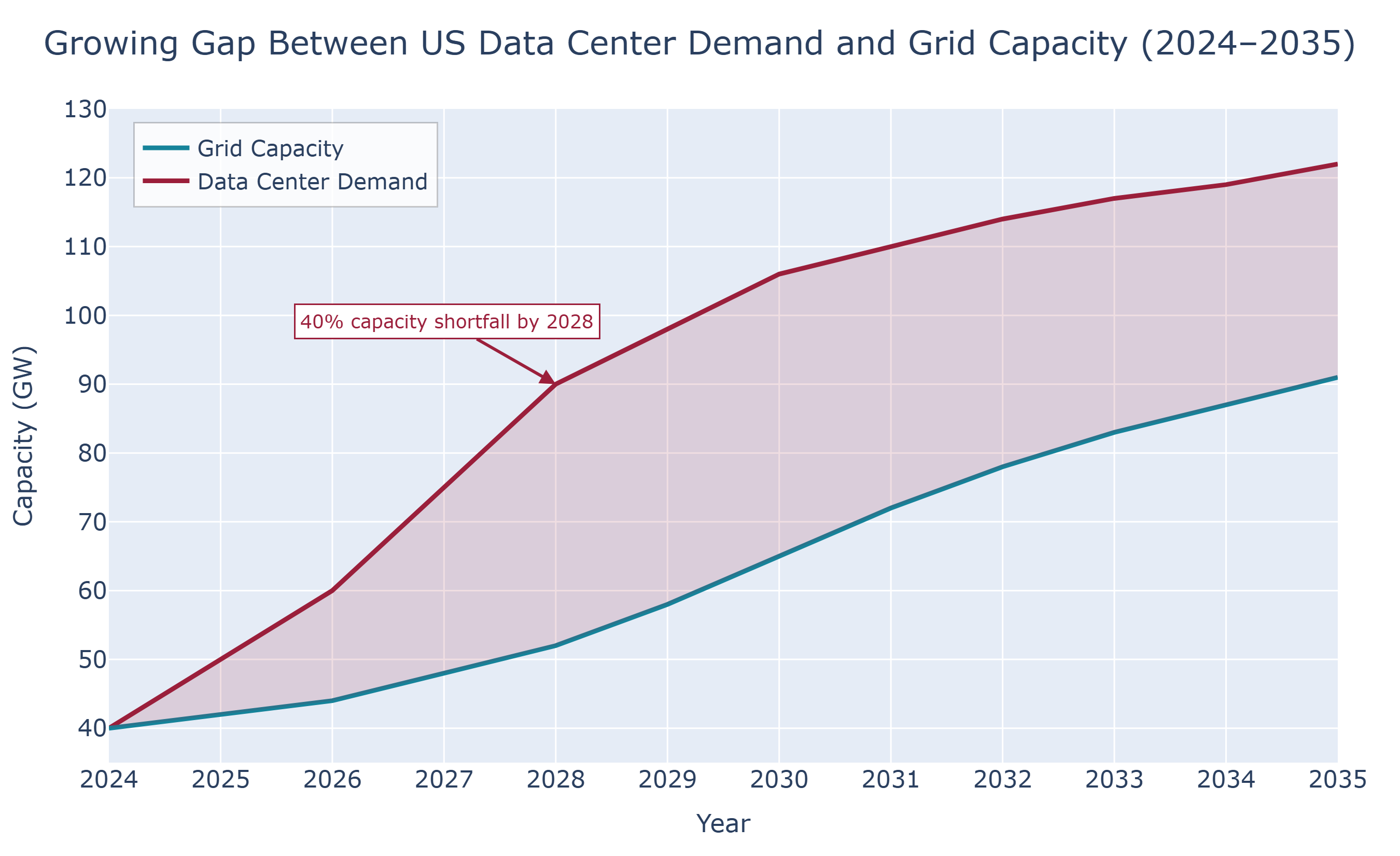
According to the International Energy Agency, global data centre electricity consumption will nearly double to the equivalent of 108 GW of continuous demand by 2030. To put that into perspective, that is roughly equivalent to the total power consumption of Japan, the world's third-largest economy.
In the United States, data centres consumed the equivalent of 21 GW of continuous demand in 2024, about 4% of national electricity demand. By 2030, that figure will hit 49 GW, an increase of 133%. Data centres now account for nearly half of America's electricity demand growth.
Eric Schmidt testified to Congress with the math: his team calculated that the United States needs to build 92 GW of new generation capacity by 2030 just to meet expected data centre demand. One gigawatt is enough energy to power about 750,000 homes. A large nuclear plant produces about 1 to 1.5 GW. Schmidt is saying we need nearly 70 to 90 new nuclear power plants' worth of power in the next five years. The number of new nuclear plants breaking ground in America? Effectively zero. The AI boom requires both chips and electrons. Whoever can supply both, fastest and cheapest, wins.
4. From Chip-Limited to Power-Limited
For years, the binding constraint was chips. Nvidia could not manufacture enough GPUs to meet demand. TSMC's fabrication plants in Taiwan ran at capacity. The US government imposed export controls to prevent China from accessing the most advanced semiconductors, betting that chip restrictions would be enough to maintain American dominance.
That bet is looking increasingly shaky. Chip production has exploded. TSMC is building new fabs in Arizona. Intel is expanding domestic manufacturing. Samsung is investing over $40 billion in Texas. The CHIPS Act is funnelling subsidies to accelerate the buildout.
But as chip supply has grown, a new constraint has emerged: power. Jensen Huang has been explicit about the shift. Energy, not semiconductors, is now the binding constraint on AI development. "China is well ahead of us on energy," he told interviewers in November 2025. China has "twice as much energy as we have as a nation" with capacity growing "straight up" while US capacity remains "relatively flat." The implications are stark. You can have all the chips in the world, stack them to the ceiling in a warehouse, but if you cannot power the cooling systems and the compute cores, they are just expensive paperweights. The question becomes: where will the power come from? Economics has a clear answer. The US government has a different one.
5. How the United States is Shooting Itself in the Foot
Here is where the self-sabotage begins.
Clean energy is the fastest, cheapest way to add power to the grid. Lazard's 2025 Levelized Cost of Energy Analysis—the industry standard for comparing electricity generation costs—shows utility-scale solar coming in at $38 per MWh and onshore wind in the same range. Combined-cycle fossil gas runs $48-109 per MWh. Coal is economically disastrous, costing at least $71 per MWh for a new plant.
Because of these economics, nearly 80% of planned power plant capacity in the US pipeline is tied to renewable sources. More than nine out of ten power plants in the interconnection queue—roughly 5,700 facilities waiting for approval—are renewable projects.
Why? Speed and cost. Most solar arrays, battery systems, and wind farms take less than five years to complete from conception to electron generation. Some are built within eighteen months. They do not require the lengthy air-quality permits of fossil fuel plants.
Robert Whaley, the director of North American power at Wood Mackenzie, put it simply: "In the next 10 years, there's really nothing to replace renewables."
And yet...
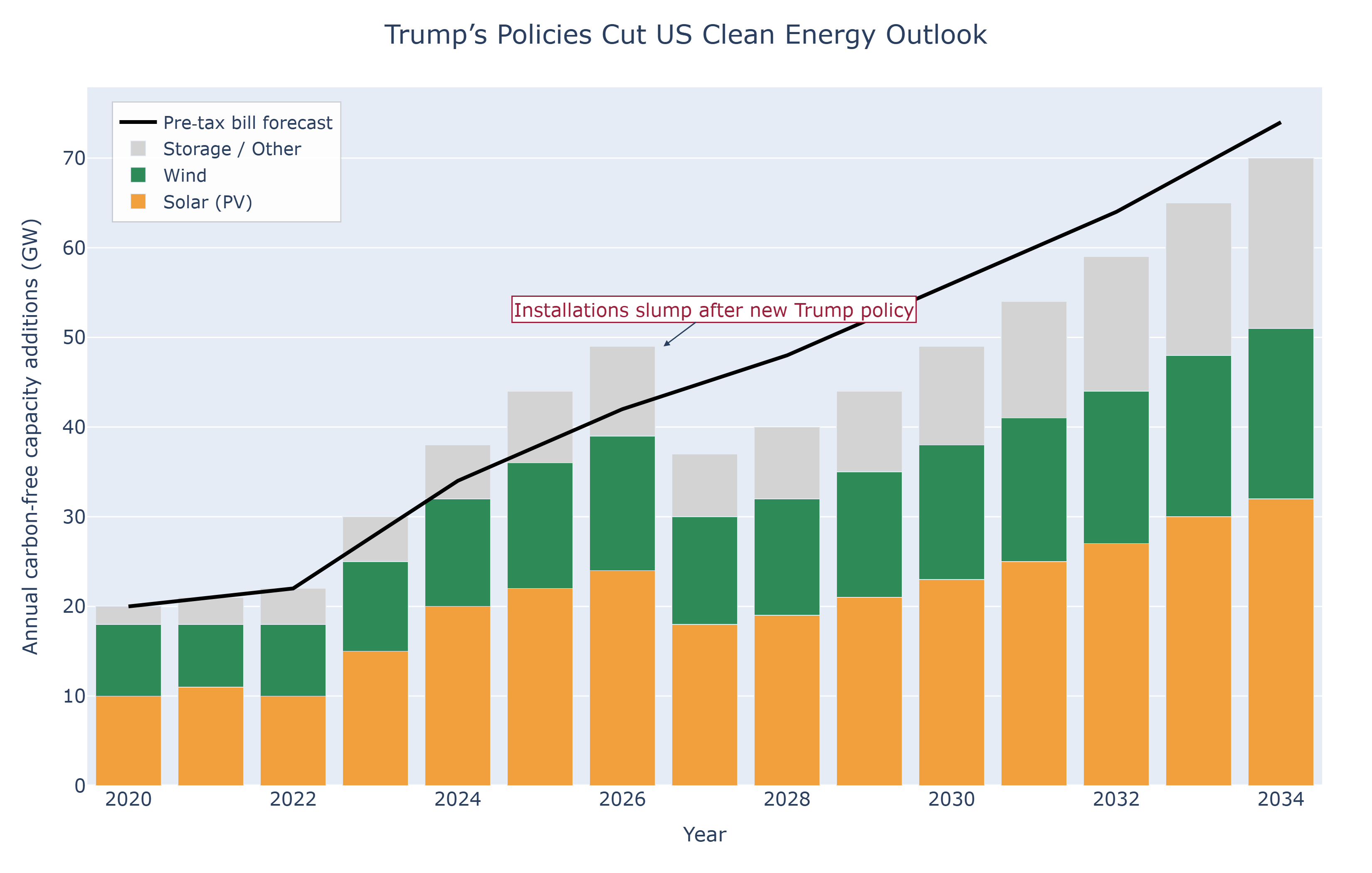
On July 7, 2025, President Trump signed an executive order titled "Ending Market Distorting Subsidies for Unreliable, Foreign-Controlled Energy Sources." Three days earlier, the so-called "One Big Beautiful Bill" terminated the clean electricity tax credits that were driving solar and wind deployment. Treasury guidance in August imposed stricter domestic content requirements that effectively froze projects in mid-development. The Interior Department cancelled the environmental permit review for Esmeralda Seven, which would have been the largest planned solar complex in North America. The $7 billion Solar for All programme was halted. $679 million in offshore wind funding was cancelled. Taylor Rogers, a White House spokesperson, defended the policy with rhetoric that flies in the face of market realities: "Intermittent and unreliable energy sources like offshore wind that were propped up by the Green New Scam simply cannot generate the sustained power needed to make the United States the global leader in cutting-edge technologies like AI."
The doublethink is remarkable. The administration claims to prioritise AI dominance while throttling the only energy sources that can actually deliver power at the speed and scale AI requires.
Eric Schmidt's verdict was blunt: "We had hoped that the government would fast-track the availability of all kinds of electricity. They have promoted oil and gas, but they've also hobbled solar and wind to a terrible degree, which is an error. The country needs more energy."
The results were immediate. First-quarter 2025 solar installations dropped to 10.8 GW, a 7% decline from the same period in 2024 and a 43% collapse from the previous quarter. Investment is fleeing to other markets. Industry analysts project 900,000 job losses and household energy bill increases of $110-400 annually. The administration is betting on fossil fuels. That bet is about to go very badly.
6. China's Clean Energy Flywheel
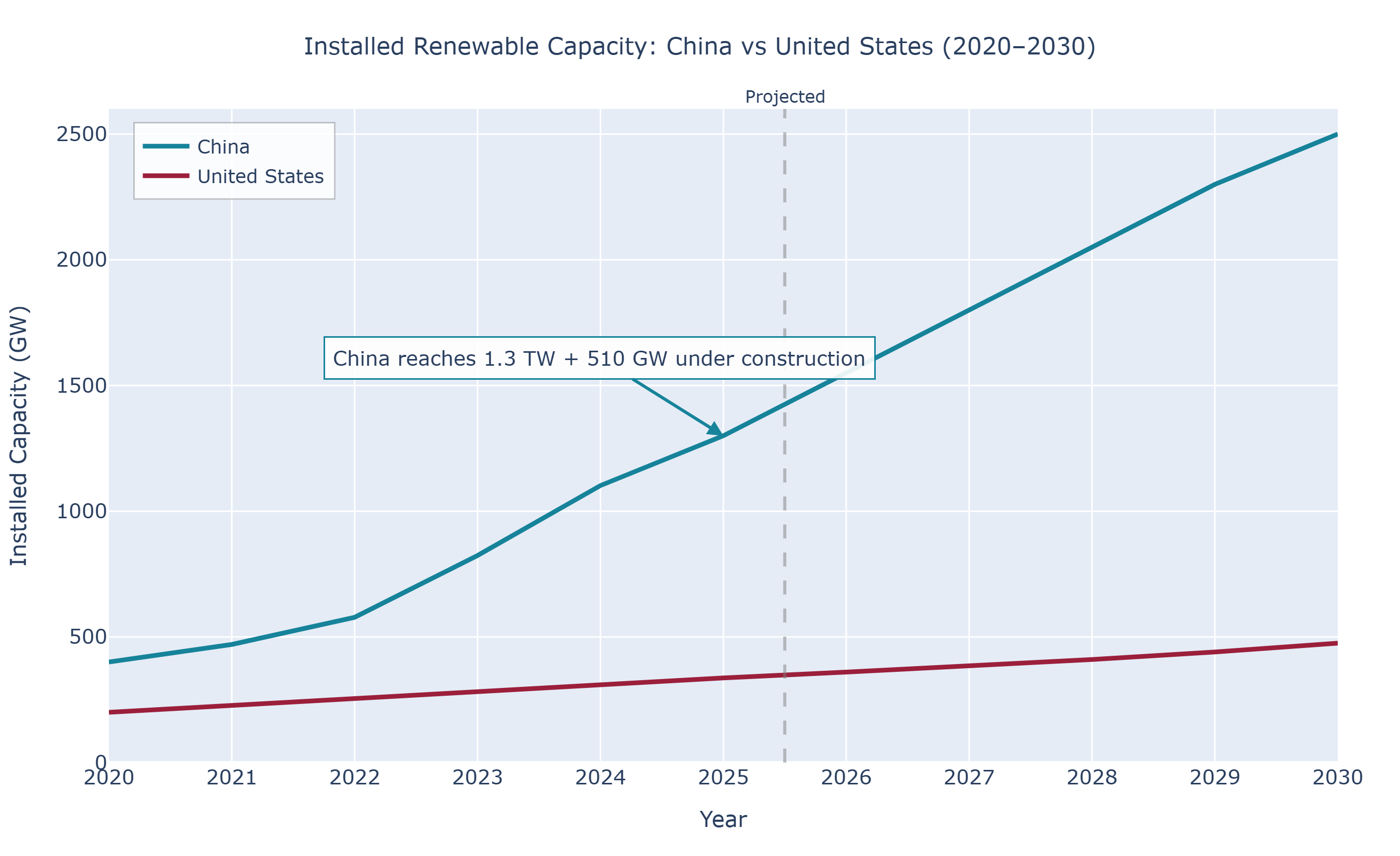
While America hamstrings its clean energy sector, China is building a machine.
Eric Schmidt described the contrast: "While the current government in the US gets rid of solar and wind subsidies, China put in 172 GW of solar last year. That number is remarkable."
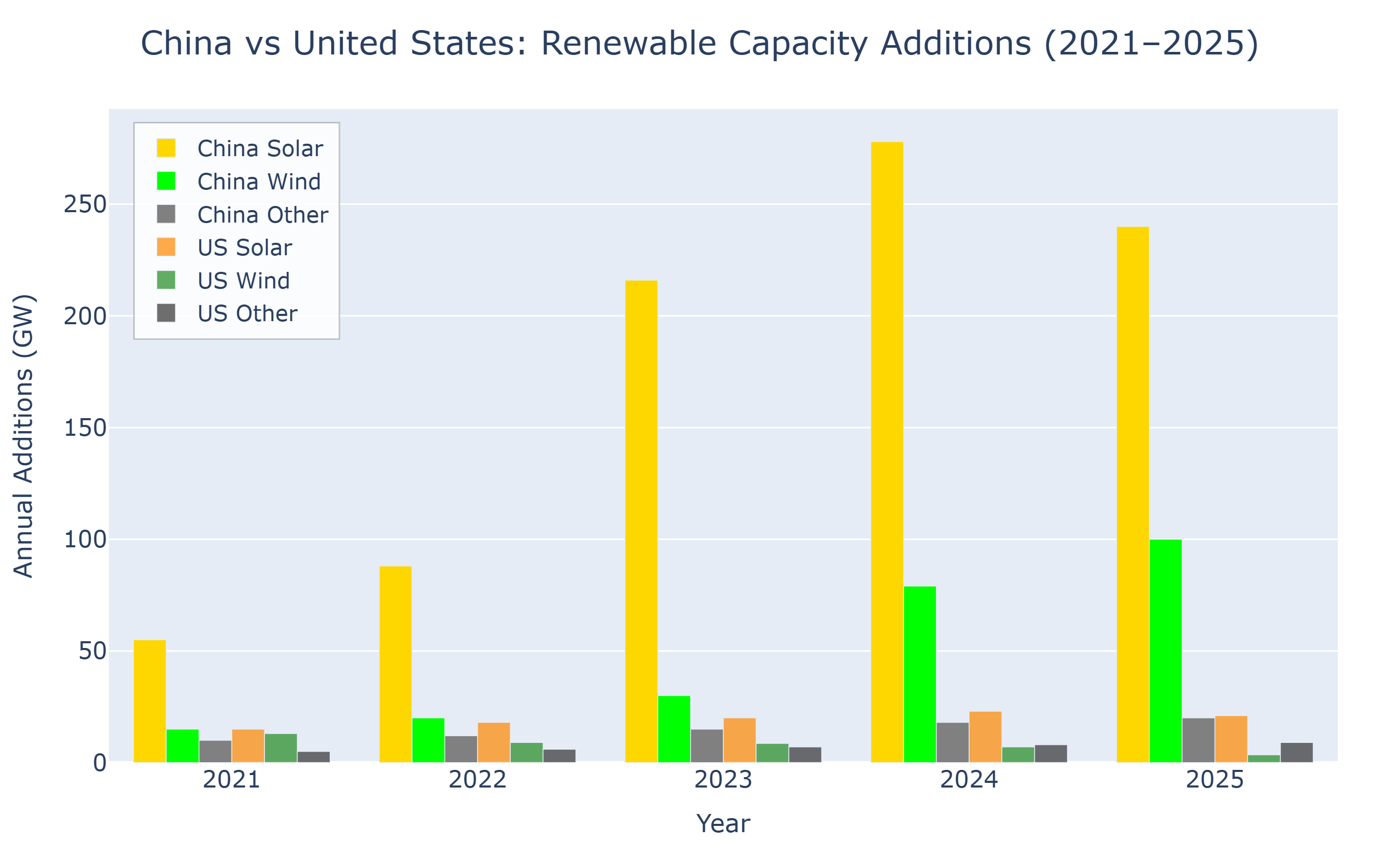
Actually, the full picture is even more striking. China added 373 GW of renewable capacity in 2024, more than 90% of their total capacity expansion and over half of all global renewable additions. The United States added about 49 GW. China outbuilt America by a factor of seven to eight. China's solar LCOE has dropped to $27 per MWh, the lowest in the world. Their monthly solar generation now exceeds 14 GW of average output, more than the entire output of America's nuclear fleet.
And yet the real advantage is strategic integration. China's "East Data, West Computing" initiative is a massive state-led engineering project that relocates data centres to western provinces like Guizhou and Inner Mongolia, where wind and solar are abundant and land is cheap. National policy requires new data centres in hub nodes to run on at least 80% renewable power.
In September 2025, the Chinese government announced an "AI+" energy integration plan that uses artificial intelligence to optimise grid management, renewable forecasting, and virtual power plant coordination. Tencent has deployed China's first integrated wind-solar-storage microgrid data centre, running on 71% green power. The strategy creates a flywheel: clean energy powers AI development, while AI optimises clean energy deployment. Each revolution of the wheel accelerates the next. China is building the infrastructure for both the AI revolution and the energy transition simultaneously because they understand these are the same project.
Schmidt observed the pattern: "The Chinese are doing the same thing in robotics that they have done in EVs... looks like they've won the race in solar and EVs."
Jensen Huang noted the speed differential: "If you want to build a data center here in the United States... probably about three years. [The Chinese] can build a hospital in a weekend."
7. The Reality of America's Bet on Dirty Power
The Trump administration's bet is that fossil fuels will fill the energy gap caused by the explosion in AI demand. Coal will make a comeback. Fossil gas will power the AI boom. Small modular nuclear reactors will arrive just in time.
None of this is grounded in reality.
Coal is dying, and no amount of subsidies will resurrect it. New coal plants cost at least $71 per MWh, nearly double solar or wind. Even with a $625 million grant programme to subsidise coal, Wood Mackenzie expects US coal capacity to decline every year going forward. The economics are brutal and irreversible. Banks will not finance them; insurers will not underwrite them.
Fossil gas faces a different problem: one cannot build gas plants fast enough. The global gas turbine market is controlled by three manufacturers: GE Vernova, Siemens Energy, and Mitsubishi Power. Together, they hold over 75% of production capacity. Their order books are full through the end of the decade.
If you place an order today for a large-frame gas turbine, you are looking at delivery in 2028 at the earliest, more likely 2030. That represents a six to seven-year wait. Costs have tripled in 24 months. A new combined-cycle plant now runs about $2,400 per kilowatt, roughly 2.5 times what it cost two years ago. In Texas, Engie withdrew two gas plant applications explicitly citing "equipment procurement constraints." They simply could not get the turbines.
Nuclear faces even longer timelines. Eric Schmidt noted that "the number of nuclear power plants getting started in America is effectively zero." Consider the Vogtle plant in Georgia, the only new nuclear construction in the US in decades. Units 3 and 4 arrived seven years late and cost over $35 billion—more than double the original budget. Small modular reactors remain a technology of the future, with the next wave not expected until the end of the decade at the earliest. Commercial fusion does not exist and will not for decades.
The administration is betting on energy sources that either cannot scale, cannot be built fast enough, or do not exist yet, while actively destroying the one source that is cheap, fast, and available.
Andres Gluski, CEO of AES Corporation, told investors: "Look, that's what can get built in this window. There can be talk about nuclear or other technologies; those take years to build. So what is going to meet the majority of the demand? Well, this year it's probably going to be 90% renewables and batteries, and it very likely will be next year as well."
8. The Green Libertarian Take
Here is the core stupidity: The administration that claims to work on behalf of the American people is ignoring the very thing on which the nation was built: free markets. By subjugating sound economic policy to ideology, the United States risks repeating the same mistakes as the Soviet Union. At the same time, its rival in the AI race has shed the shackles of communism to embrace market forces.
Solar and wind are cheapest. They deploy fastest. The supply chain exists. Fossil gas faces turbine shortages and rising fuel costs. Coal is economically dead. Nuclear takes decades. Fusion is a pipe dream.
Yet the current administration has decided that fighting economic reality matters more than winning the AI race. Ideology has become a negative externality. Nobel Prize-winning economist Friedrich Hayek warned against exactly this kind of hubris. In The Road to Serfdom, he wrote: "The curious task of economics is to demonstrate to men how little they really know about what they imagine they can design." The central planners in Washington imagine they can design an energy market based on coal and gas, ignoring the price signals screaming for renewables.
There is a historical parallel here that should terrify anyone who remembers the 20th century.
The Soviet Union tried to compete with the United States by overriding market signals. Central planning would deliver superior outcomes, the commissars believed. Politics would triumph over economics, and the USSR would see its living standards rise above that of the "decadent West." We all know how that turned out. Empty shelves, bread queues, and a technological backslide that led the USSR to become completely irrelevant in the Information Technology revolution of the late 20th century.
The current US approach to energy policy rhymes uncomfortably with that history. Picking losers (coal), propping up constrained alternatives (fossil gas), and promising technologies that do not exist (fusion, SMRs), while actively destroying the one sector that is actually delivering cheap, fast, scalable power. The Chinese Communist Party, meanwhile, is running circles around America by being better capitalists in the energy sector. They call it "socialism with Chinese characteristics." Schmidt calls it "pure, raw capitalism." Whatever one calls it, it is working.
Letting political slogans override economics is the path to strategic decline. The Soviets learned this the hard way. America appears determined to repeat the lesson.
9. Conclusion: All Hope Is Not Lost
Return to the stadium. Our self-sabotaging runner is still ahead, but she is stumbling in her work boots while her competitor closes the gap with every lap, lacing up her Nike Alphafly 3s.
The race is not over. Yet. But the window for course correction is closing. The United States is full of strategic thinkers, and there are signs pragmatism may yet prevail over ideology.
Robert Whaley at Wood Mackenzie offered a political observation: "MAGA has to be MAGA; they have to keep the base fired up. But privately, I think there will be concessions, because they don't want to lose the AI race to China."
Despite the executive orders and the Big Beautiful Bill, renewable projects continue getting built. Through September 2025, renewable sources comprised 89% of new electrical generating capacity. Wood Mackenzie only lowered its renewable projections by 8% after subsidies were gutted. The big tech companies contracted for 9.6 GW of clean energy in the first half of 2025 alone.
The voters are noticing, too. In the November 2025 off-year elections, Democratic candidates in Virginia and New Jersey won decisive victories after centering their campaigns on energy affordability and clean energy deployment. Governor-elect Spanberger of Virginia and Governor-elect Sherrill of New Jersey both pledged to make energy more affordable by making it easier to build low-cost clean energy. As Advanced Energy United's president put it: "These elections send a clear message to every statehouse in America: clean energy wins."
A rational course correction is possible.
- First, streamline permitting. The United States takes five years to approve projects that China builds in two. The administration's fight against bureaucracy should be put into motion by enabling things to be built, not just clean power generation, but the high-voltage transmission lines needed to bring that power to data centres.
- Second, stop picking losers. If solar and wind are cheapest, stop artificially propping up coal and constrained fossil gas. Let price signals work.
- Third, integrate strategy. Energy policy is AI policy. AI policy is national security. If America wants to continue being the dominant economic and military power in the world, it must break down the policy silos. Beijing knows this—China is playing chess while America plays whack-a-mole.
America still has the best chips, the best models, and the best talent. But talent flows to where infrastructure exists. Innovation requires power. And in the 21st century, that power is renewable.
Our runner can still win. But she needs to throw off those work boots and put her racing shoes back on. The technology exists. The economics work.
The only question is whether America will listen before China crosses the finish line.