In which the Don of Mar-a-Lago tilts at offshore wind turbines, gets thrashed 5-0 in court, and manages to raise the very prices he promised to lower.
Prologue: Of Dons and Delusions
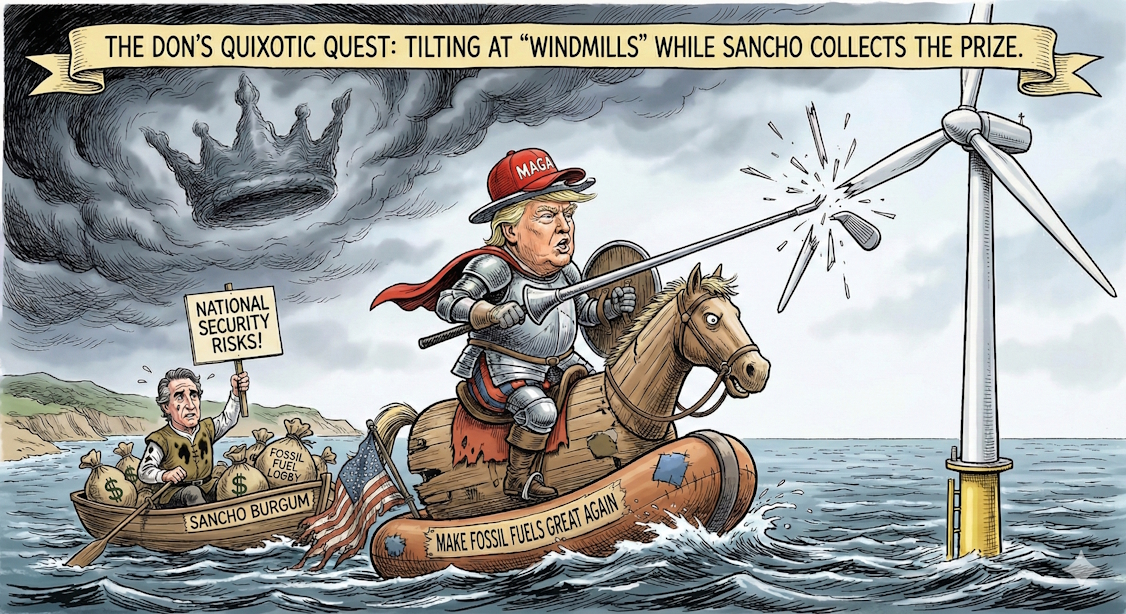
There is a scene in Cervantes' masterpiece where Don Quixote, surveying the plains of La Mancha, spots a row of windmills and declares them to be "lawless giants" that must be vanquished. His faithful squire Sancho Panza tries to dissuade him. "Those are not giants, master," Sancho pleads, "they are windmills." Don Quixote charges anyway, gets his lance tangled in the sails, and is flung unceremoniously to the ground.
Four centuries later, another Don, this one operating out of a gilded Florida estate rather than a crumbling Spanish manor, has picked up where the original left off. Except this Don's windmills are real, they generate clean electricity for millions of Americans, and his assault on them is not a solo act of romantic delusion but a coordinated campaign bankrolled by the fossil fuel industry. Oh, and unlike the original Quixote, who at least had the excuse of having read too many chivalric romances, this one's animosity towards wind turbines appears to trace back to something far more pedestrian: a lost planning dispute over an offshore wind farm near his Scottish golf course.
One might laugh. But the consequences are anything but funny.
Chapter I: "National Security" and Other Fairy Tales
On 22 December 2025, just days before Christmas (because nothing says "peace on earth" like kneecapping a clean energy industry), the U.S. Department of the Interior issued what may be one of the most Orwellian press releases in the history of government communications. Its headline: "The Trump Administration Protects U.S. National Security by Pausing Offshore Wind Leases."
Read that again. Protects national security. By halting the construction of clean energy infrastructure that would power over 2.5 million American homes in the states that most desperately need it!
Interior Secretary Doug Burgum, playing the role of Sancho Panza to Trump's delusional knight (though one suspects Sancho Burgum's saddlebags are considerably heavier, stuffed as they are with fossil fuel campaign contributions), announced that all five offshore wind projects under construction on the U.S. East Coast were to cease work immediately. The stated reason? "National security risks identified by the Department of War in recently completed classified reports." Apparently, wind turbines create radar "clutter" that could obscure legitimate military targets.
Now, here is where it gets truly absurd. These projects had already undergone years of regulatory review, including by the Pentagon, the Federal Aviation Administration, the U.S. Army Corps of Engineers, the Coast Guard, and the Naval Undersea Warfare Centre. As retired Commander Kirk Lippold (former Commander of the USS Cole) pointed out, the Department of Defense [now renamed the Department of War in another echo of Orwell] was consulted at every single stage of the permitting process. The radar interference issue has been known about for decades, and mitigation measures were built into the project approvals from the start.
As Brown University researcher and professor J. Timmons Roberts put it when asked about the administration's classified security claims: "bonkers."
But the real question is not whether the national security argument holds water (it does not, as five federal judges would shortly confirm). The question is: why?
Chapter II: Follow the Money, Not the Windmills
Here is where the Green Libertarian starts twitching, because this story is a textbook case of what happens when concentrated economic power captures the regulatory apparatus, which is precisely the kind of market distortion that any self-respecting libertarian should find revolting.
The Brown University Climate and Development Lab has done the forensic work that should make every free market advocate's blood boil. Their research, published in the peer-reviewed journal Energy Research & Social Science, mapped out the sprawling network of anti-offshore wind groups operating along the U.S. East Coast. The findings? What appears to be organic, grassroots opposition to wind farms is, in many cases, a carefully orchestrated campaign funded by fossil fuel interests and dark money donors. The researchers estimate that conservative and so-called libertarian think tanks with ties to legacy fossil fuel interests have channelled at least $72 million into the opposition movement since 2017.
The network is a masterclass in astroturfing. Groups with names like "Green Oceans," "Deep Sea Defenders," and "Save the Right Whales" give the impression of concerned citizens worried about marine life. Dig beneath the surface (as the Brown team did) and you find the American Coalition for Ocean Protection (ACOP), founded by the Caesar Rodney Institute, a libertarian think tank that has received funding from American Fuel and Petrochemical Manufacturers and the American Energy Alliance. The same network connects to Environmental Progress, a nonprofit known for downplaying climate risks while undermining renewable energy. The same organisations share legal support, speakers, leadership, and talking points. It's an "information subsidy," as the researchers politely term it: a fancy way of saying that Big Oil writes the script and the puppet groups perform it.
And the Centre for American Progress confirmed what the Brown study mapped: a complex network of oil-and-gas-funded interest groups is spreading anti-offshore wind misinformation. One of these groups successfully petitioned none other than Interior Secretary Doug Burgum to issue the December stop-work orders.
The letter ordering the halt was signed by Matthew Giacona, acting director of the Bureau of Ocean Energy Management. His previous job? Lobbyist for the National Ocean Industries Association, the oil and gas industry's trade group. Congressional Democrats asked the Interior Department's inspector general to investigate Giacona after revelations that he was using his government position to work on policy matters that were previously the focus of his oil lobbying role.
If you are a genuine free market advocate (and I count myself as one), this should make you furious. This is not the invisible hand at work. This is a fossilised industry using its political connections to throttle a cheaper, cleaner competitor. It is the very opposite of free market competition. It is crony capitalism at its most brazen, dressed up in the language of national security, and having the audacity to claim that it is "decreasing the energy costs for ordinary Americans" while the U.S. Department of Energy's own website states that Trump has "made it a central mission of his administration to lower costs and stabilize the grid."
Sancho Burgum, it seems, received a generous dose of oil-soaked cash before saddling up.
Chapter III: Five Courts, Five Defeats, Zero Self-Awareness
Here is the part of the story where reality, that stubborn thing, refuses to cooperate with Don Trump's fantasies.
Within weeks of the December freeze, developers of all five projects challenged the stop-work orders in court. And every single time, the courts sided with the wind farms. Five lawsuits. Five federal judges ruled against the administration. A perfect record of failure, or as CNN delightfully put it: wind developers are now "5-0 in court battles with the administration."
Judge Royce Lamberth, issuing the fifth and final injunction to allow the Sunrise Wind project off New York to resume construction, found that the government had "not shown that offshore wind is such an imminent national security risk that it must halt in the United States." Which is a polite judicial way of saying the emperor has no clothes and his lance is broken.
But while the Don of Mar-a-Lago was busy losing in court, the damage was already being done. Dominion Energy, developer of the Coastal Virginia Offshore Wind (CVOW) project, which is the largest offshore wind farm in the United States capable of powering 660,000 American homes, reported that the construction halt cost $228 million in delays. Add another $137 million from tariffs (because why not wage a trade war at the same time as an energy war?) and you have a project whose price tag ballooned from $11.2 billion to over $11.5 billion. Sunrise Wind was haemorrhaging $1.25 million per day during the stoppage. And the nearly complete Revolution Wind project, serving Rhode Island and Connecticut, faced similar losses, with union workers alone standing to lose $28 million in wages and benefits if construction had never resumed. Yes, those same union workers whose interests the Don of Mar-a-Lago claimed to represent.
And who pays for these cost overruns in the end? If you guessed "the American consumer," give yourself a gold star. Or rather, give yourself a higher electricity bill, because that is what you are getting.
Chapter IV: The Price You Pay for Tilting at Windmills
And this, dear reader, is where the farce becomes a tragedy, because the man who promised Americans he would lower their energy costs is actively, measurably, driving them up.
Let me lay out the numbers, because unlike the delusional Don, the Green Libertarian believes in evidence.
The Centre for American Progress published its analysis on the same day as Trump's rambling, 108-minute State of the Union address (we will get to that spectacle shortly). Their findings: if developers are forced to cancel the five frozen projects, ratepayers across 15 states and Washington, D.C. would pay close to an additional $100 every year, on average, for the next decade. The American Clean Power Association puts the total cost even higher: $45 billion in additional electricity bills over ten years.
But it gets worse. A report by RENEW Northeast, using real electricity market and meteorological data from the winter of 2024-2025, found that if just 3,500 MW of contracted offshore wind had been operational last winter, New England wholesale energy prices would have dropped by more than 10%, saving consumers approximately $400 million collectively. Connecticut's Department of Energy and Environmental Protection (DEEP) estimated that cancelling Revolution Wind alone would cost New England ratepayers roughly half a billion dollars per year in higher regional energy market costs.
Why? Because offshore wind acts as a natural hedge against the very price spikes that hammer Northeast consumers every winter. When a cold snap hits New England (and they do, with regularity), demand for natural gas surges for both heating and electricity generation. The region sits at the end of the national gas pipeline system, which means supply gets squeezed precisely when demand peaks. During Winter Storm Fern in January 2026, natural gas prices shot up 17%. Offshore wind, by contrast, produces its strongest output in winter, carries zero fuel cost, and bids into the wholesale market at essentially zero marginal cost. It is, to use the technical term, a "winter powerhouse" resource. ISO New England's own CEO testified that offshore wind provides "substantial reliability benefits," offsetting the constraints on the gas pipeline system during winter.
In other words, offshore wind does not compete with cheap energy. It is cheap energy. Killing it means burning more expensive gas. Which means higher bills. Which means Trump's war on windmills is, in the most literal sense imaginable, an own goal of historic proportions.
Chapter V: The State of the Union (and of Reality)
Which brings us to Tuesday night, when Don Trumpijote of Mar-a-Lago stood before Congress for a marathon 108-minute State of the Union address and, with a straight face, boasted about lowering costs for Americans. He cheered falling gasoline prices. He claimed inflation was "plummeting." He announced a "rate payer protection pledge" to ensure that data centres do not drive up electricity bills.
Here is what he did not mention: electricity prices are up 6.3% since he took office in January 2025, according to the Bureau of Labor Statistics. Grocery prices are up 2.1%. Housing is up 3.4%. And the specific policy actions his administration has taken on offshore wind, the very projects designed to provide affordable electricity to the Northeast, have added hundreds of millions of dollars in unnecessary costs.
The irony is staggering. Trump acknowledged during his own speech that Americans are worried about data centre demand driving up their bills (which is true; AI-driven electricity demand is surging). His proposed solution? Telling tech companies to build their own power plants. Meanwhile, his administration is simultaneously kneecapping the construction of offshore wind farms that were specifically designed to meet that very demand. In Virginia, where CVOW is being built, power demand from data centres is exploding. The grid operator PJM warned in legal filings that delaying the project would cause "irreparable harm to the 67 million Americans served by PJM."
Chapter VI: A Quixotic Legacy
Let us take stock of what Don Trump's war on windmills has actually accomplished:
He froze five offshore wind projects. He lost all five court cases. Construction has resumed on all five. The delays cost developers (and ultimately consumers) hundreds of millions of dollars. The projects will still be built, but they will be more expensive than they needed to be, and those costs will eventually flow through to ratepayers. Meanwhile, the signal sent to the broader offshore wind industry is catastrophic: according to BloombergNEF, only about one-fifth of the 30+ GW of offshore wind capacity the Biden administration had targeted for 2030 is now likely to be built. Warren Leon, executive director of the Clean Energy States Alliance, summarised the outlook bluntly: no other projects beyond these five are likely to move forward for the next three years. In these three years, U.S. electricity demand is projected to grow at the fastest rate since 2000, with the EIA forecasting 1% growth in 2026 and 3% in 2027, driven largely by data centres, while ICF projects total demand to increase by 25% by 2030 from 2023 levels.
While Trump was railing against "windmills" as "losers" at Davos and telling oil CEOs that his goal is "to not let any windmill be built," nine European countries were signing a deal to build 100 GW of offshore wind in the North Sea, the largest clean energy hub in the world. Meanwhile China installed more wind and solar in 2024 than the total amount of renewable energy operating in the entire United States! As Professor Thijs Van de Graaf of Ghent University noted, on energy policy the U.S. is now "aligned with petrostates like Saudi Arabia, the United Arab Emirates, and Russia."
Truly Making America Great Again.
Epilogue: What a Free Market Would Actually Do
Here is the thing that should infuriate any genuine libertarian, any genuine conservative, and believer in free market economics: offshore wind does not need government mandates to succeed. It needs the government to get out of the way.
These five East Coast projects were approved through a multi-year regulatory process. They secured private financing. They negotiated power purchase agreements with willing buyers. They are filling a genuine market need: reliable, affordable, winter-peaking electricity for a region where demand is growing and supply is constrained. The market spoke. The developers listened. The projects moved forward.
And then the government stepped in. Not to support a market outcome, but to sabotage one. Not because the economics did not work, but because the incumbent fossil fuel industry, which has bought the loyalty of the Interior Secretary and planted its former lobbyists in regulatory positions, decided that competition was inconvenient.
Cervantes' Don Quixote was a tragic-comic figure because his delusions harmed only himself and his long-suffering horse. The Don of Mar-a-Lago's delusions are raising electricity bills for millions of Americans, costing workers their jobs, undermining grid reliability, and handing strategic advantage to America's geopolitical competitors.
And unlike the original, this Don is not insane. He knows exactly what he is doing. He just does not care, because the people paying the price are not the ones writing the campaign cheques or pumping his crypto scams.
And Sancho Burgum trots obediently behind, pretending the windmills are giants, because the oil industry told him so.
The windmills, meanwhile, both on- and offshore, keep turning. And with each turn they will keep bringing cheap electricity to millions of Americans long after the Don has ridden off into the sunset.
Sources
U.S. Department of the Interior, "The Trump Administration Protects U.S. National Security by Pausing Offshore Wind Leases," 22 December 2025
Brown University Climate and Development Lab, "Against the Wind: A Map of the Anti-Offshore Wind Network in the Eastern United States," 2024
Centre for American Progress, "The Oil and Gas Industry Is Behind Offshore Wind Misinformation," 2023
Centre for American Progress, "The Trump Administration's Attack on Offshore Wind Threatens to Raise Electricity Prices for Millions of Americans," 26 February 2026
RENEW Northeast / Daymark Energy Advisors report on offshore wind price suppression, August 2025
Connecticut DEEP analysis of Revolution Wind economic impacts, August 2025
Union of Concerned Scientists / RENEW Northeast wholesale price analysis, 2025
CNN, "Trump's attempts to kill offshore wind aren't working," 2 February 2026
Fortune, "Fifth offshore wind farm wins legal battle against Trump," 3 February 2026
Stateline, "Offshore wind triumphs over Trump in court, but future projects face delays," 19 February 2026
E&E News / Politico, "After beating Trump, offshore wind project aims to produce power next month," 24 February 2026
PBS / AP, "Trump order halts offshore wind projects for at least 90 days," 24 December 2025
Canary Media, "'Bonkers': DOI letter halts all five in-progress offshore wind farms," 22 December 2025
PBS / NPR / CNN / ABC News, Fact checks of Trump 2026 State of the Union address, 25–26 February 2026
Bureau of Labor Statistics, Consumer Price Index data, January 2026
U.S. Energy Information Administration, Short-Term Energy Outlook, January 2026
ICF, "U.S. Electricity Demand Expected to Grow 25% by 2030," June 2025
U.S. Department of Energy, "Promises Made, Promises Kept," January 2026