The summer of 2026 is showing that the “Nuclear Renaissance” is not just full of empty promises, but that it is increasingly becoming “intermittent” due to climate-change.
Forty years ago
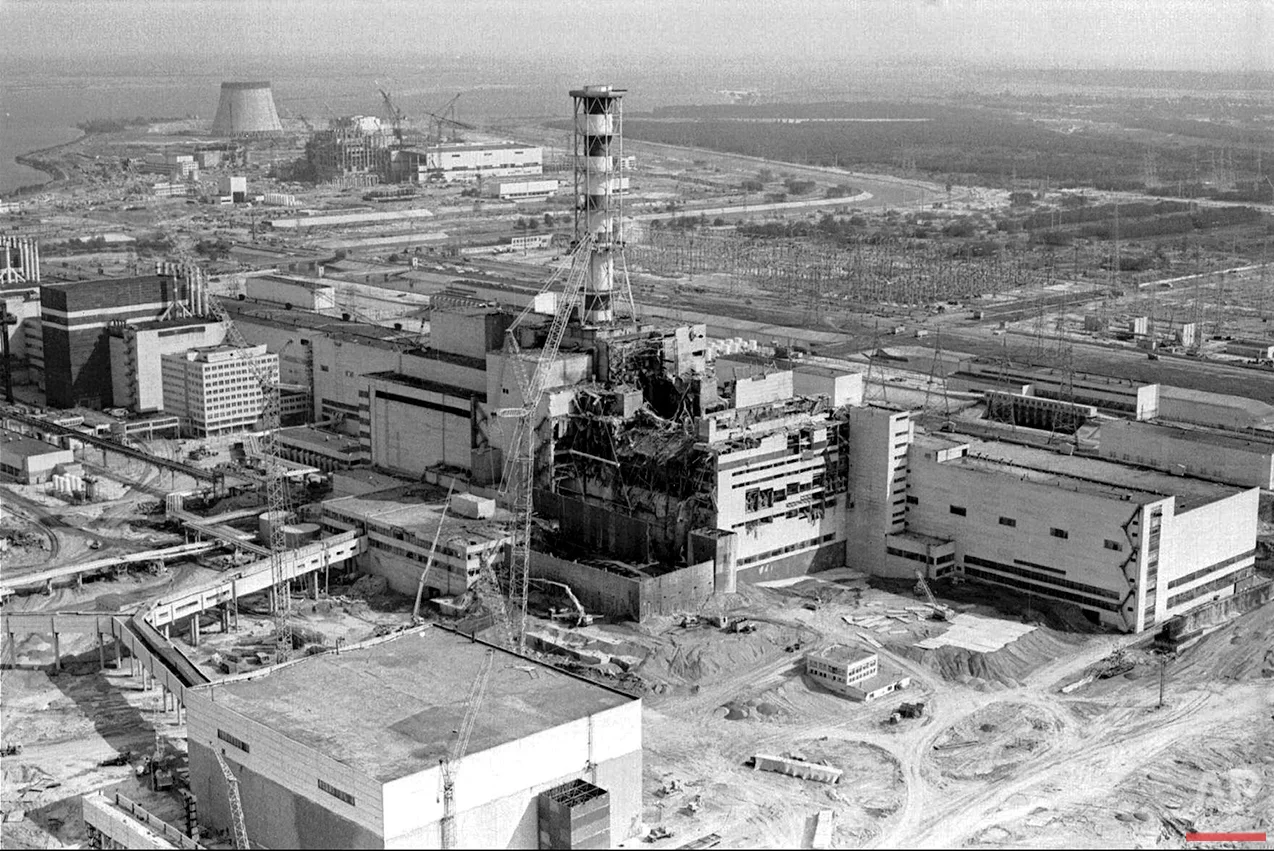
Over 40 years ago, on April 26th, on a beautiful sunny day in what was then the USSR, ordinary people were going about their lives, enjoying the spring sunshine yet struggling to survive in the increasingly dysfunctional late Soviet economy. They were not aware that something had happened that morning that would directly impact their lives and change the course of history. Unbeknownst to them, in what was then Soviet Ukraine, a nuclear meltdown, caused by a flawed reactor design and a mishandled safety test as well as disregarded safety procedures, was burning1 uncontrollably and spreading a radioactive cloud over a large part of Eastern Europe. It was only a few days later, when Swedish authorities registered a spike in radiation and questioned its source, that a sliver of truth began to emerge, and the Soviet authorities could no longer hide the scale of the accident.
Although the green libertarian could still walk under the dining room table with a sizable clearance and could barely reach the fourth-floor lift button at his grandparents’ flat where he was staying, he still remembers the dread, in one of his earliest childhood memories. He clearly remembers his grandparents gathered around the television trying to explain to him what radiation was, and that the cloud had reached the southern part of the Leningrad Oblast where they used to take their holidays. Luckily for him, Leningrad, his birth city, was spared the worst effects, like a majority of the population centres of the Soviet Union. Thousands of citizens of the former Soviet Union were not so lucky. While the official immediate death toll was just 31, the World Health Organization has estimated that up to around 4,000 people may eventually die from radiation exposure among the most affected populations, with broader estimates running far higher.2
The Chernobyl disaster, as it subsequently came to be known, not only changed the course of world history by arguably accelerating the fall of the Soviet Union, by demonstrating the ineptitude of the government in dealing with it, but also put a damper on the enthusiasm for developing nuclear power as the dominant source of the world’s electricity, an enthusiasm that had already been waning since the world`s first serious nuclear accident, at Three Mile Island in Pennsylvania in 1979. A note on terms: when the Green Libertarian refers to nuclear power he means nuclear fission, where electricity comes from a steam turbine driven by the energy released when heavy atoms such as uranium-235 are split. This is not the same as nuclear fusion, a much safer and potentially far more powerful technology that is, unfortunately, still stuck in the theoretical, dreamed-of stage. We shall explore that another day. For now, back to the fission story.
The Three Mile Island accident showed that nuclear power was not infallible. Its direct impacts were limited: the partial meltdown released only a small amount of radiation and caused no deaths and no detectable harm to public health.3 But it marked the moment the earlier, unbridled enthusiasm for nuclear power began to fade. Chernobyl, on the other hand, was a visceral demonstration of exactly what the technology’s detractors had feared and warned about. Everything that could go wrong did. A safety test done wrong turned into the worst nuclear disaster in history. What began as a utopian post-war dream of unifying the world through the power of the peaceful atom became a cautionary tale. In the years that followed, the growth of nuclear power slowed sharply and new reactor construction in the West all but halted. Twenty-five years later, another accident, at the Fukushima Daiichi plant in Japan, brought on by a magnitude 9.0 earthquake4 and the tsunami that followed, turned the public further against Nuclear power. Japan shut down its entire fleet and imposed a moratorium on new plants, and Germany, too, resolved to abandon Nuclear altogether, with far-reaching consequences that the Green Libertarian detailed in a previous post.5
Nuclear power was not entirely abandoned, though. China, in particular, grasped its potential to feed a fast-growing economy, and unlike the West or Japan it kept building: the number of Chinese reactors grew from a single unit connected to the grid in 1991 to roughly 55 today, the largest new-build programme in the world.6 And even in the democracies with the fiercest opposition to nuclear power, a quiet rethink has set in, with the post-hoc realisation that turning away from nuclear inadvertently accelerated climate change by deepening the reliance on fossil fuels.
In fact, over the last five years, as the climate crisis has grown more urgent and electricity demand has exploded, driven in large part by artificial intelligence (AI), nuclear power has been enjoying a renaissance. From France, which generates the highest share of its electricity from nuclear of any country, around 65 per cent,7 walking back its plan to phase the technology out; to Japan restarting its dormant fleet; to the United States bringing its first newly built reactors in a generation online, at Plant Vogtle in Georgia, in 2023 and 20248, it is firmly back on the agenda. Investors are increasingly banking on Nuclear as a low-carbon source of baseload power, set against ‘intermittent’ wind and solar, and new concepts such as the small modular reactor, or SMR, are being pitched as the breakthrough.
So, is the post-war utopian dream still alive? Is Nuclear really the ‘too cheap to meter’ baseload its proponents promise, or is it a bottomless money pit, beset by delays, struggling to put electrons on the grid while draining resources from cheaper, faster forms of clean energy? And what about the effects of climate change? Could nuclear power ironically become the victim of climate change instead of being the rescuer?
On the 40th anniversary of Chernobyl, and 15 years since the tsunami inundated Fukushima, the Green Libertarian will look at the question through his usual economic lens, and try to answer it: is nuclear fission really the answer to 21st-century power demand and the fossil-fuel-driven climate crisis?
Nuclear dreamers
From where we stand in 2026, caught in a superposition of a deepening climate crisis and the vertical take-off of artificial-intelligence power demand, the question is a $1-trillion one: is the jet-age nuclear dream finally coming true, at a moment when we do not have a spare dollar or euro to waste?
The honest answer, and the Green Libertarian has never been in the business of platitudes, is that the dream died a long time ago, and the people now selling it back to us are not dreamers. They are sleazy salesmen. Some of them sell artificial intelligence. Some of them sell uranium. A worrying number sell both, often in the same breath and the same pitch deck.
To the chagrin of the ‘nuclear bros’, the answer is a resounding no: Nuclear is not the solution to the climate crisis, nor to the sovereign-energy crisis, nor to the AI data-centre crunch. And because the Green Libertarian likes his arguments the way he likes his Russian novels, long and in chronological order, here they are. Chernobyl (1986) showed us the astronomical human cost of nuclear power when it fails. The British debacle at Hinkley Point C, still gloriously unfinished, shows the cost is astronomical even when it works. The Fermi America affair of 2025 and 2026, the so-called Trump reactor, shows what happens when you take a faded sepia dream from the 1950s and slap it onto the share price of a well-connected company, with a healthy dose of corruption stirred in. And finally, this summer, the record-hot and dry Euopean summer of 2026 proved that nuclear reactors are not the heroes helping to power a society in the midst of a spike in power demand; they are rapidly becoming victims as the lack of water for cooling is forcing the shutdown of major European reactors as I write this article.
The trade-off that is not a trade-off
Let us begin with a steelman argument, a move every nuclear advocate makes within ninety seconds of any debate, which is to point out, correctly, that renewables are not spotless. Solar panels need silicon and silver. Batteries need lithium, cobalt and nickel. Wind turbines need rare earths and a great deal of steel and concrete. And the path that carries all of it from the ground to your rooftop or field runs largely through China, not exactly a bastion of open markets and individual liberty. Mining is dirty, supply chains run through unpleasant places, and anyone who tells you the energy transition is a frictionless garden of virtue is selling you something too. Granted. The Green Libertarian has never pretended otherwise.
But here is where the conversation usually goes wrong, and where he wants to plant a flag. The tempting reply is that renewables have smaller, more manageable trade-offs than nuclear. That is too soft, because it treats the two as the same kind of problem at different sizes. They are not even in the same league, and the gap in scale is the whole argument.
When renewable energy goes wrong, the damage is real but small and short-lived. In July 2024 a blade snapped off a turbine at the Vineyard Wind farm off Massachusetts and scattered fibreglass across the beaches of Nantucket at the height of the tourist season. It was ugly and embarrassing, the beaches shut for a few days, the debris was cleared over the following weeks, the manufacturer paid the island $10.5 million,9 and within a season it was over. A lithium brine in the Atacama, a cobalt pit in the Congo, the rare-earth mines of Inner Mongolia: filthy, certainly, but problems of regulation, technology and recycling, the kind we fix on human timescales. You can clean a river. You can recycle a battery. You can shut a bad mine and let the land come back within a working lifetime.
A nuclear accident is a different animal altogether, and not by a little. The Chernobyl Exclusion Zone covers roughly 2,600 square kilometres, later enlarged to about 4,140, and it has been sealed off for 40 years.10 It will not be safe to live in for centuries, in places for tens of thousands of years, and no minister, regulator or clever start-up can argue that timeline down, because it is fixed by the stuff lying in the soil: caesium-137 and strontium-90 take about 30 years merely to halve, and plutonium-239 takes 24,000. The worst day renewable energy can hand you is a beach full of fibreglass, cleared in a month. The worst day nuclear can hand you is a county-sized dead zone you cannot enter for longer than human civilisation has existed. That is not a difference of degree. It is thousands of times worse, and that is the whole argument.
Hinkley Point C, or what Nuclear costs even when it works
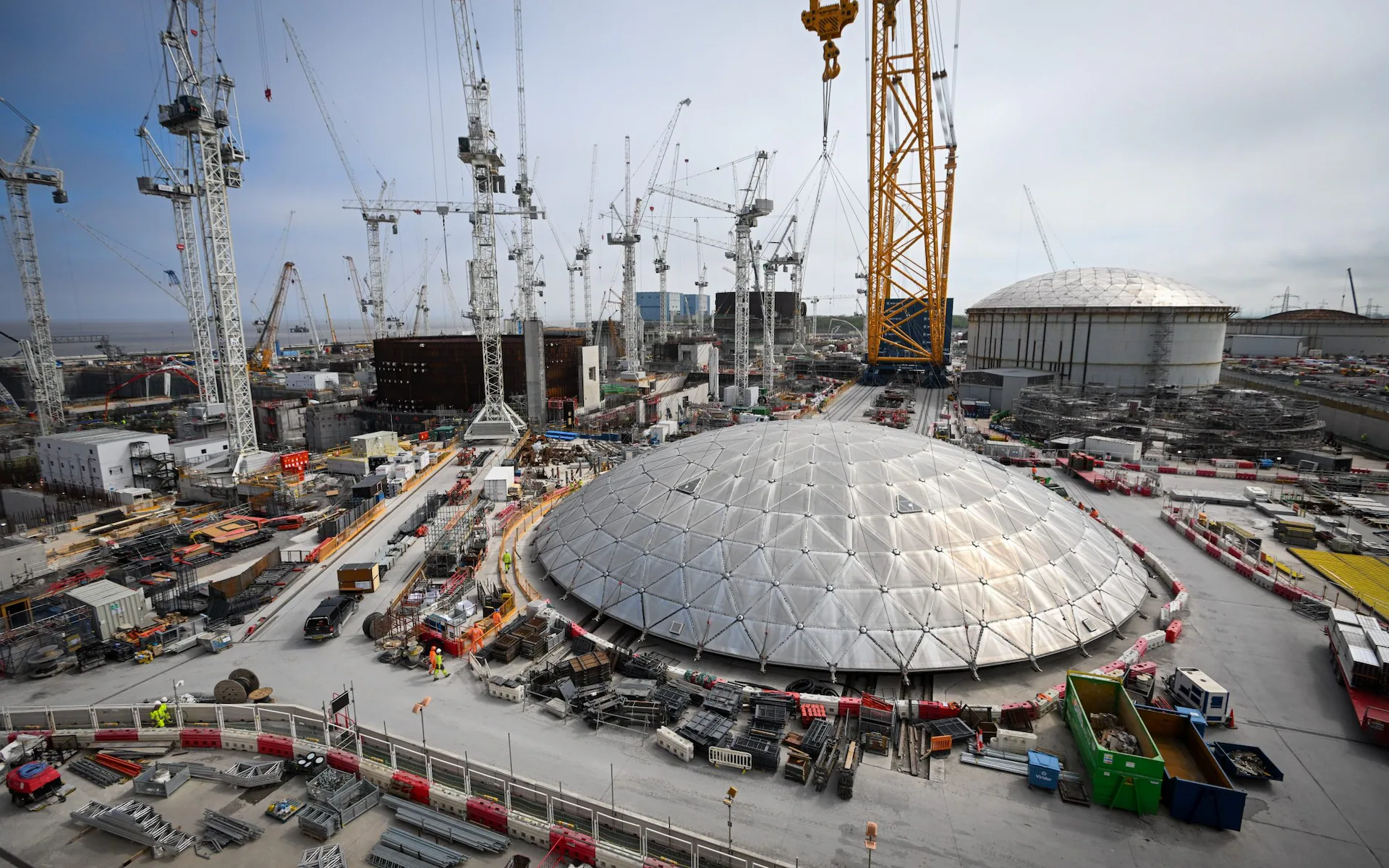
Chernobyl shows what happens when Nuclear fails. Hinkley Point C, on the Somerset coast in the UK, shows something almost worse, what happens when it works. It was meant to be Britain’s poster child for the nuclear renaissance, proof, in theory, that home-built nuclear could deliver steady, low-cost power as an alternative to variable renewables and to capricious fossil gas with its exposure to geopolitical shocks. Except that it hasn’t. Instead, Hinkley Point became a byword for cost overruns, and for what happens when a good idea on paper collides with regulatory and market reality.
When the deal was struck, the cost was put at around £18 billion, with first power promised for 2017, a date that came and went years ago. It is now 2026. The latest estimate has climbed to about £35 billion in 2015 prices, something like £46 to £49 billion in today’s money, and is still climbing, while the first reactor is now expected to generate power around 2030, give or take a delay or three.11 The chart tells the story at a glance: measured per kilowatt of capacity, Hinkley’s installed cost has roughly doubled, from about $11,000 at the 2016 go-ahead to about $20,000 by 2024, which, by the analyst Michael Taylor’s reckoning, makes it the most expensive commercial nuclear project on Earth, 2.5 times the cost of solar, 2.9 times offshore wind and 5.5 times onshore wind.12
The truly instructive number is the strike price, the guaranteed rate the operator is paid for its electricity. It was set at £92.50 per megawatt hour in 2012 money, index-linked to inflation and locked in for 35 years; because it tracks inflation, in today’s money it is already worth considerably more.13 Compare that with what Britain has actually been buying clean power for in the meantime. In the September 2024 Contracts for Difference auction, solar cleared at £50.07 per megawatt hour and onshore wind at £50.90, with fixed-bottom offshore wind around £58 to £59, all on 15-year contracts, not 35.14 The same money poured into Hinkley’s 3.2 gigawatts would, in wind and solar, have bought far more energy, sooner, at well under half the price. And for anyone still claiming in 2026 that wind and solar are too intermittent to count, look at what batteries have done to the British grid in two years: operational battery capacity has jumped from about 1.1 gigawatts in 2020 to roughly 7 gigawatts by the end of 2025, a record 4 gigawatt hours of it added in 2025 alone, even as storage costs have fallen about 93 per cent since 2010.15
And then there is the part that should make every Reform-voting energy-sovereignty hawk choke on his cuppa. Hinkley Point C is built and operated by Électricité de France (EDF), the French state utility, with China General Nuclear (CGN), a Chinese state enterprise, as its original co-investor, on British soil and paid for over 35 years by British bill-payers. A French state firm and a Chinese state firm, underwritten by the British public, selling Britain its own electricity at a guaranteed, inflation-linked price worth more than double today’s wholesale rate, under a contract that runs into the 2060s. Remind me, slowly, where exactly the sovereignty is in that arrangement.
The Fermi Paradox: how a washed-up ex-governor of Texas sprinkled fairy dust in the eyes of unsuspecting investors
Which brings us to the present, and to the single most perfect illustration of this whole argument, one the Green Libertarian could not have invented if he tried. Meet Fermi America, a firm co-founded by Rick Perry, former United States Energy Secretary, former governor of Texas, and a man whose curriculum vitae is not exactly light on oil and gas. And lest you think the Trump in the title is a cheap rhetorical flourish, it is not. Fermi’s flagship development in Carson County, Texas, is registered, in genuine federal paperwork, as the President Donald J. Trump Advanced Energy and Intelligence Campus, and its reactors as the Donald J. Trump Generating Plant. The licence application is public.16
The pitch is the purest distillation of the 2026 vibez: build reactors, power data centres, ride the AI boom, save the climate, get extremely rich, bro. The share price of this supposed magic money machine has had other ideas. Fermi went public around 1 October 2025 in a dual Nasdaq and London listing, raising about $682 million at a roughly $13.8 billion valuation. The stock duly spiked above $26 within days, briefly worth nearly $20 billion, because in 2026 you could attach the word ‘nuclear’ to almost anything and watch retail investors stampede. It then did what overhyped assets running on vibes and fumes tend to do: the share price crashed through the floor. By 20 April 2026 its market value had collapsed to about $3.4 billion, the shares down more than 78 per cent from the listing; the chief executive Toby Neugebauer and the chief financial officer had both abruptly departed, the company had rebranded itself ‘Fermi 2.0’ (always a reassuring sign), and the ousted chief executive had opened a proxy fight to claw his way back in. Somewhere in late 2025 an investment-grade tenant had also walked away from a $150 million construction-funding commitment, knocking the shares down some 46 per cent in a single morning.17
But the share price is not the punchline. The punchline is that the cheap, abundant nuclear power Fermi promised the data-centre boom turned out to be equally hot air. Project Matador, as the campus is called, proposes up to 11 gigawatts of ‘behind-the-meter’ power, and that power is to come from a mix of Westinghouse nuclear reactors, solar arrays, and fossil gas turbines, six Siemens SGT-800 units, with financing already arranged for delivery in 2028, years before any reactor.18 Read that again. The nuclear-for-AI company has quietly bolted fossil gas and solar onto its flagship site, because the reactors will not be ready in time and the data centres need electrons this decade, not in the 2030s. When the people selling you nuclear quietly build fossil gas and solar to keep the lights on while they wait, you know the game is up.
And lest anyone think this is a Fermi-specific embarrassment, recall the most recent American reactors actually finished, Vogtle Units 3 and 4 in Georgia, the same Westinghouse AP1000 design Fermi is banking on. They came in at roughly $35 billion against an original $14 billion, more than double, and about seven years late, and bankrupted their own main contractor, Westinghouse, along the way.19 Fermi’s first Trump-branded reactor is not targeted before 2031, and the nuclear construction has not even begun.
And Washington has just doubled down on exactly that design. In June 2026 the Energy Department offered up to $17.5 billion in loans to build ten more large reactors, two apiece at five sites, every one of them a Westinghouse AP1000. The money is not even for construction: it buys the long-lead components, the reactor vessels and steam generators that take years to forge. The utilities and Westinghouse together are expected to find about $5 billion of equity, against $17.5 billion of public debt, an arrangement the Energy Secretary Chris Wright called 'very, very low risk to the American taxpayers'. Seven companies have signed letters of intent and five will be picked, though the department declines to name the utilities or even the states, on the grounds that saying so would be premature. Construction is meant to begin by 2030 and the reactors to generate some time in the mid-2030s.20
Wright's account of Vogtle is that it suffered from bad planning, supply-chain trouble and the pandemic, and that the design itself is 'robust and sound'. His promise is that the new fleet will 'well outperform what was done on Vogtle'. Perhaps. What the Green Libertarian finds instructive is where the sharpest objection came from. Not from an environmental group, but from the Cato Institute, which is about as libertarian an address as Washington possesses. Its director of energy policy studies, Travis Fisher, conceded that the department has the legal authority, and then made the point that actually lands: the executive branch should not be this deeply embedded in the electricity business, because the next administration will simply use the same powers to favour a different set of technologies. 'Remove the state barriers and the federal favoritism,' he wrote, 'and let companies build the power plants that pass the market test.'21 Quite. A technology that was genuinely the cheap and obvious answer would not need $3.5 billion of federal debt per project simply to get its parts on order.
But the bros say Small Modular Reactors change everything
At this point a certain kind of reader, the sort with a ring-light, a podcast and strong opinions about both Bitcoin and seed oils, is typing furiously that the Green Libertarian is attacking a straw man. Nobody serious, he says, defends great lumbering Hinkley-style plants any more. The future is the Small Modular Reactor, or SMR: a reactor small enough to be built in a factory and trucked to site, in theory cheaper, faster and safer than the giants. The Green Libertarian, an avid follower of alternative opinions and an occasional listener to these very podcasts, has heard the SMR refrain many times, often from a testosterone-laden voice singing the praises of ‘the real alternative energy’ between musings about alien sightings and adverts for certain green powders.
It is a lovely story, and largely the same lovely story it has been since 2010. Let us run an unbiased check on the protagonists. NuScale, the most advanced American SMR developer, watched its flagship Utah project collapse in November 2023 after the target price climbed from $58 to $89 per megawatt hour, and likely past $100 with inflation, and its municipal customers walked.22 The others are further along than they were, which the Green Libertarian will concede honestly: TerraPower, the Bill Gates venture, finally began construction on its 345-megawatt Natrium plant in Wyoming in April 2026, under the first such permit the US Nuclear Regulatory Commission has ever issued, aiming for a 2030 start, and Rolls-Royce has signed contracts in Britain and Sweden through 2026. But, and it is the whole ‘but’, not one of these reactors has produced a single commercial electron yet, and the earliest realistic dates cluster around 2030 and beyond.
Meanwhile, the thing an SMR would have to beat keeps getting cheaper. Between 2010 and 2024 the levelised cost of solar electricity fell by about 90 per cent and the cost of battery storage by about 93 per cent, and both are still falling.23 This is the part the bros miss: pair cheap solar with cheap batteries and you no longer have a daytime-only source, you have something that behaves more and more like round-the-clock baseload, and you can build it in months rather than a decade. By the time the first commercial SMRs actually switch on, somewhere in the 2030s, they will not be racing today’s grid; they will be racing solar-plus-storage that is cheaper still. The reactor is chasing a target that is sprinting away from it.
‘But that was Soviet incompetence.’ Fukushima says otherwise
There is one last argument the nuclear bros make, and it is the most reasonable-sounding of the lot. Chernobyl, they say, was a Soviet reactor with a communist safety culture run by an incompetent and secretive bureaucracy; we won the Cold War, we can do better than that, and a reactor built in the capitalist, economically developed ‘Western world’ simply cannot melt down.
Except for Fukushima Daiichi. That was a General Electric Mark I boiling water reactor, a Western design, operated by a private utility, the Tokyo Electric Power Company (TEPCO), in Japan, a country not famous for cutting engineering corners. On 11 March 2011 a magnitude 9.0 earthquake and a tsunami of up to roughly 14 metres knocked out the cooling, three cores melted down, two hydrogen explosions tore the buildings open, and a large release of caesium-137 and iodine-131 followed. TEPCO, it later emerged, had been warned about exactly this tsunami risk to its seawalls and backup generators years earlier, and had done nothing.
Fifteen years on, the site still holds about 1.3 million cubic metres of treated water in roughly 1,000 tanks, whose release through the ALPS filtration system began in August 2023 and is expected to take about 30 years. Hundreds of square kilometres remain restricted or hard to return to, and the Japanese government’s own estimate for the whole disaster runs to about ¥21.5 trillion, around $141 billion, this for a country that has struggled ever since with a soaring fossil-fuel import bill.24 The lesson is not that the Japanese are incompetent. The lesson is the opposite, and far more uncomfortable: complex systems with extreme tail risks fail in ways their designers did not foresee, and when they fail the cleanup is measured in generations, even when the engineers are among the best in the world.
The summer of 2026, or when the cure caught the disease
And then there is the newest argument of all, which has been unfolding on the Green Libertarian’s screen while he was writing this article. It goes like this: the technology sold to us as the answer to the climate crisis is turning out to be one of its more spectacular casualties.
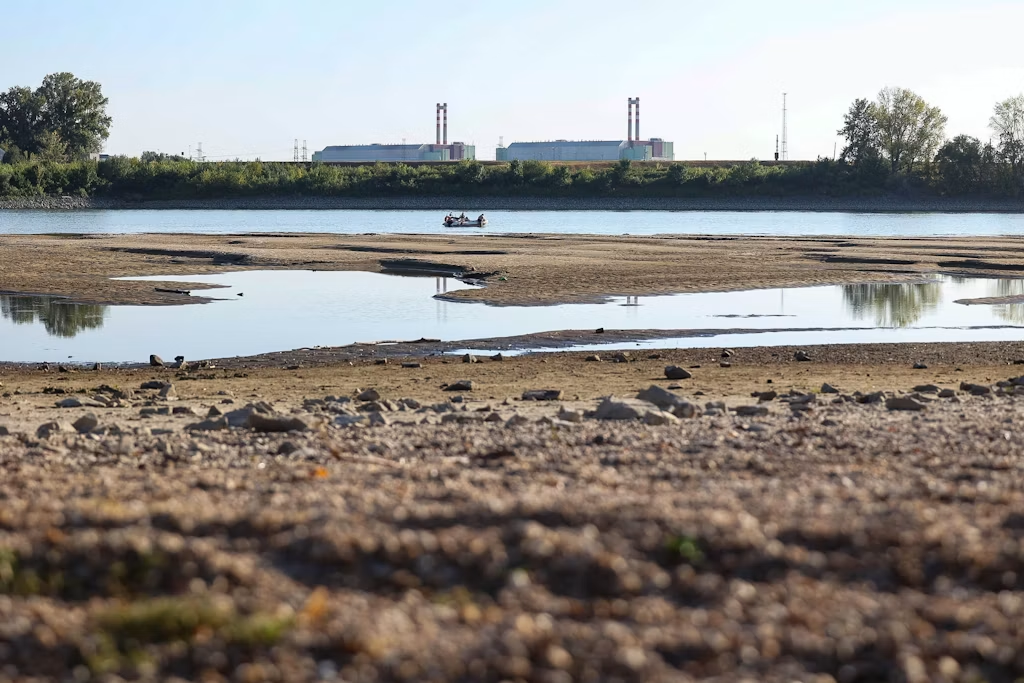
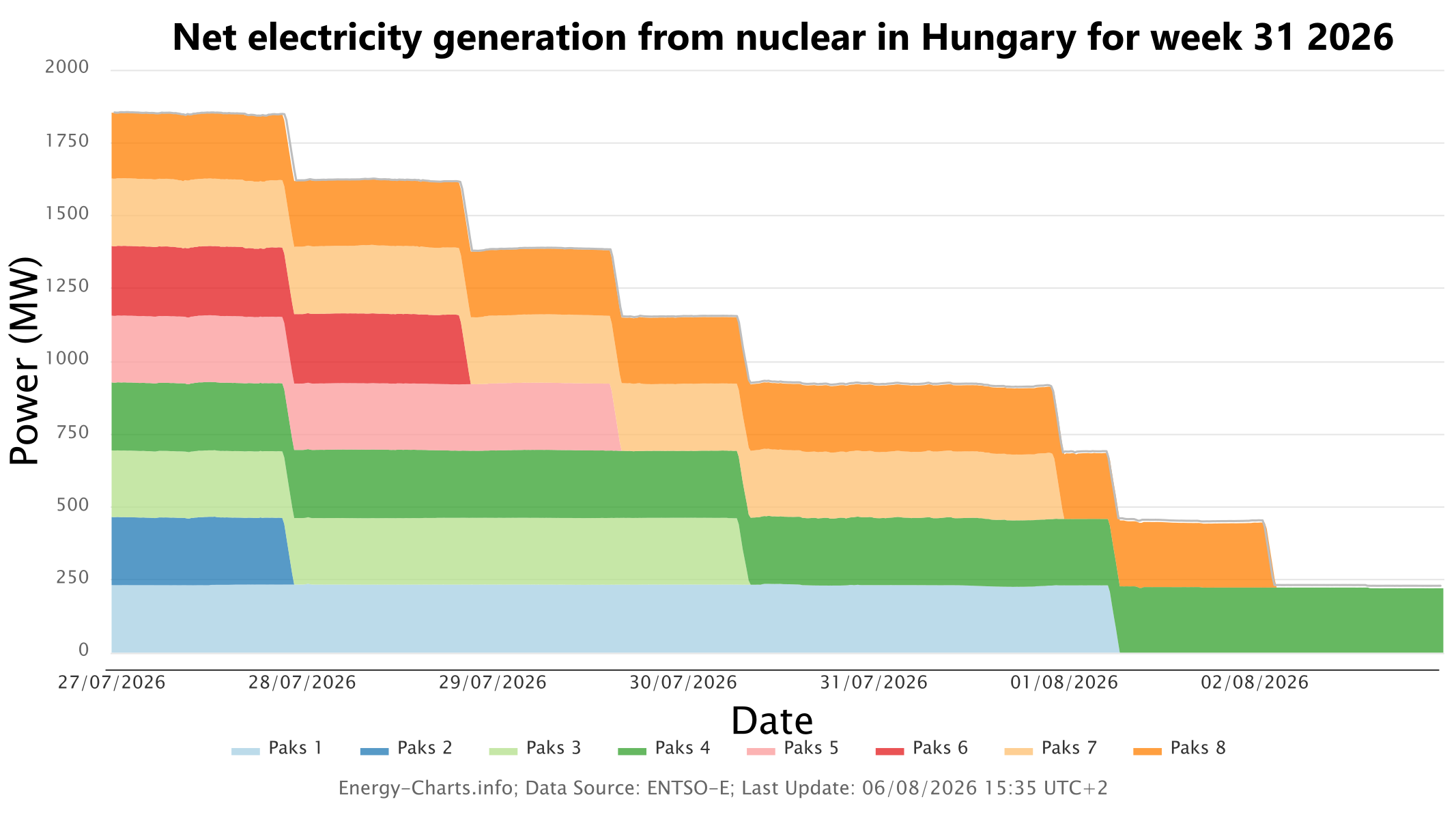
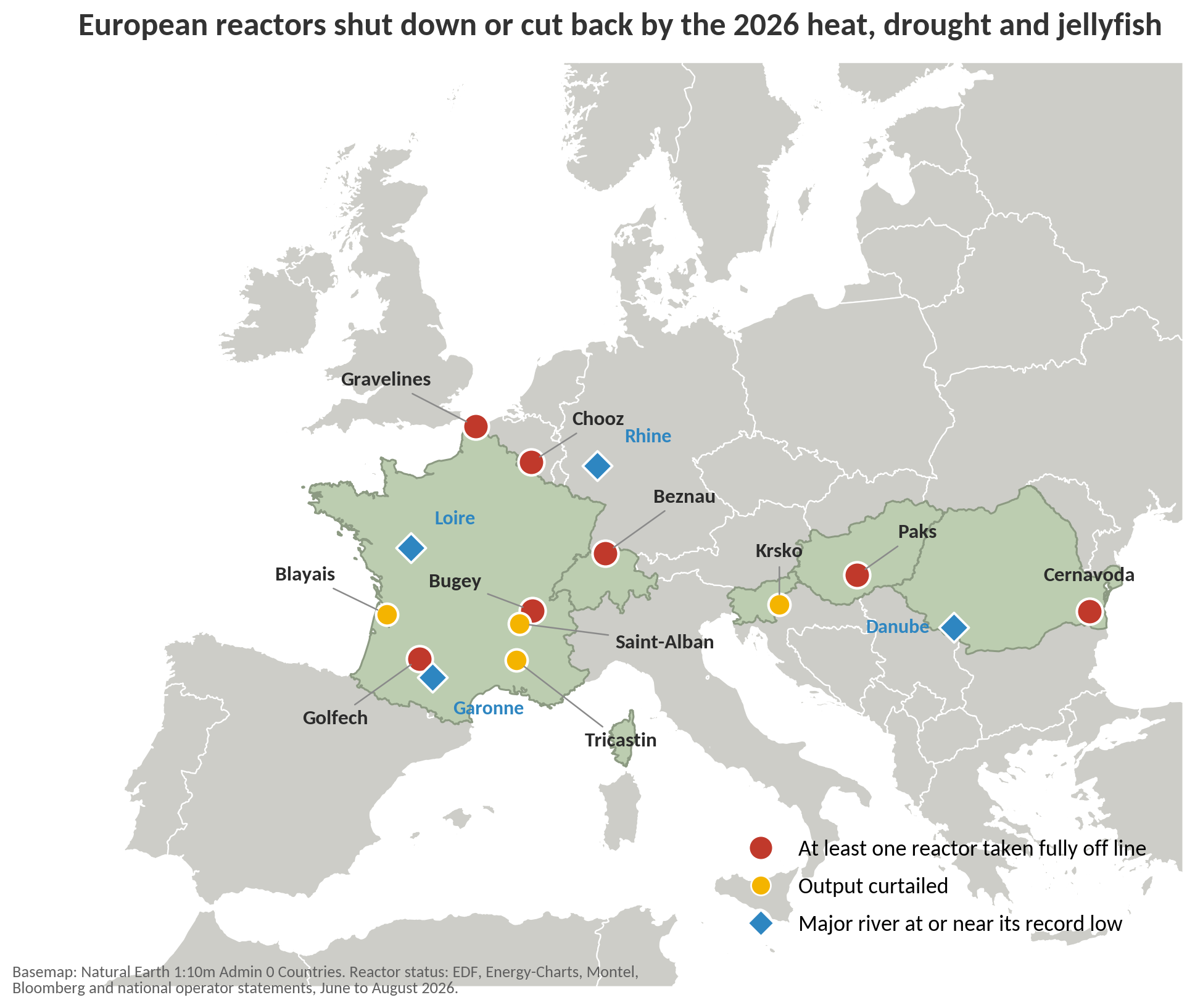
Start with Hungary. The Paks plant, four Soviet-built reactors sitting on the Danube, produces close to half of the country’s electricity. Through the last week of July 2026, it powered down unit by unit as the river fell away beneath it, until by 1 August it was limping along at about a quarter of its 2,000 megawatts. Then it stopped altogether, the first complete shutdown in the plant’s 44-year history, with the new prime minister, Péter Magyar, warning it might be weeks before it runs again. The trigger is not a political decision but a number on a gauge: at minus 134 centimetres the pumps can no longer draw enough water to cool the reactors, and the Danube was forecast to fall to minus 144, far below the previous record low of minus 98 set in 2018.25
Downstream in Romania the response was less bureaucratic and considerably more cinematic. With one of the two reactors at Cernavodă already shut for want of cooling water, the Romanian army sent in military engineers and divers to blow up the Parjoaia cliff with some 180 kilograms of explosives, the object being to slow one branch of the Danube and shove more of what water remains along the old channel towards the plant. Over a hundred military personnel were involved. The government declared a national energy state of alert for August, having worked out that losing the second reactor would take roughly a fifth of the country’s electricity with it.26 Sit with that image for a moment. A NATO member deployed its armed forces to dynamite a river so that its nuclear power station could keep running.
It did not work. On 13 August Nuclearelectrica began a controlled shutdown of the second reactor and Cernavoda went dark. Romania had spent more than 2 million euros on the rescue, dynamiting the cliff and then sinking four barges loaded with rock into the river to shove the flow towards the intakes, and the Danube dropped below the level the pumps need regardless. It is the first time since 2003 that drought has stopped the plant outright, and its director, Romeo Urjan, said he did not expect a restart within ten days. That is a fifth of Romania's electricity gone in the middle of August, to be replaced by wind and imports while the energy ministry appeals for responsible consumption and warns that large industrial users may be rationed in the evenings.27
Upstream, Hungary was busy with engineering of its own. Peter Magyar's government ordered a submerged weir built in the Danube near Paks and stationed two 80 metre barges beside the plant, ready to be sunk if the level drops again. Copernicus now puts flow rates along nearly two thirds of the Danube at their lowest in more than thirty years.28 Two governments are re-plumbing Europe's second longest river so that their reactors can keep running, and one of them has already lost.
And then there is France, which matters most of all, because France is the example every nuclear advocate reaches for. Sixty-five per cent of its electricity, the largest fleet in Europe at around 61 gigawatts, and the most experienced nuclear operator on the planet. It has spent this summer switching parts of that fleet off. In June, EDF pulled about 5.5 gigawatts, some 8.7 per cent of installed capacity. In July, as the thermometer hit a record 43 degrees, the cuts reached 5.7 gigawatts, about 9 per cent. On 30 July, Golfech unit 2, all 1,300 megawatts of it, shut down completely because the Garonne had grown too warm; Chooz 2 and Bugey 3 went offline; Saint-Alban on the Rhone, Blayais on the Gironde and Tricastin were throttled back in rolling curtailments.29 None of this is a malfunction. It is the rules working exactly as intended, because a reactor may not discharge water hot enough to cook the river it sits in, and the legal ceiling sits somewhere around 26 to 28 degrees.
And it was not only the big three. In Switzerland, both reactors at Beznau came off the grid on 26 June, the day the Aare touched the 25 degree ceiling written into the plant's licence, and spent the following weeks cycling between full shutdown and half power. In Slovenia, Krško began winding its reactor down to 80 per cent on the night of 6 August, with the Sava running close to three metres below normal and a legal limit of 28 degrees on the water it returns downstream; the plant has warned it may have to stop altogether, which would pull electricity out of Croatia as well. Tally up the summer and at least ten reactors across five countries were either shut or throttled by heat and low water.30 This was not a French problem, and it was not an eastern European problem. It was a continental one.
In fairness, one plant on the same shrunken Danube kept going. Bulgaria's Kozloduy held both its reactors at full output right through the record low, using deep intake channels and 34 high-power pumps, having stood up an emergency task force in early July to manage the drought.31 The Green Libertarian is happy to give credit where it is due. But look at what 'reliable baseload' actually required that month: a crisis task force, a bank of emergency pumps, and, a few hundred kilometres upstream, an army blowing up a cliff to move the river. Kozloduy did not sail serenely through the drought. It fought it, and it won, this time.
And then, on the night of 11 August, came the failure mode nobody had put in the risk model. At Gravelines on the Channel coast near Dunkirk, the largest nuclear power station in western Europe, a swarm of jellyfish drifted into the seawater intake drums and clogged the pumps that feed the cooling system. Three reactors tripped, a fourth had its output halved, and with a fifth already down for maintenance that left one unit out of six at full power and roughly 3.2 GW off the grid. EDF was quick to say there was no impact on the safety of the installations, which is true and entirely beside the point. The same plant had been stopped by the same animal the previous August. Warming seas, overfishing of the things that eat them and plenty of plastic to spawn on are all pushing jellyfish blooms up, and Gravelines sits precisely where they wash in.32
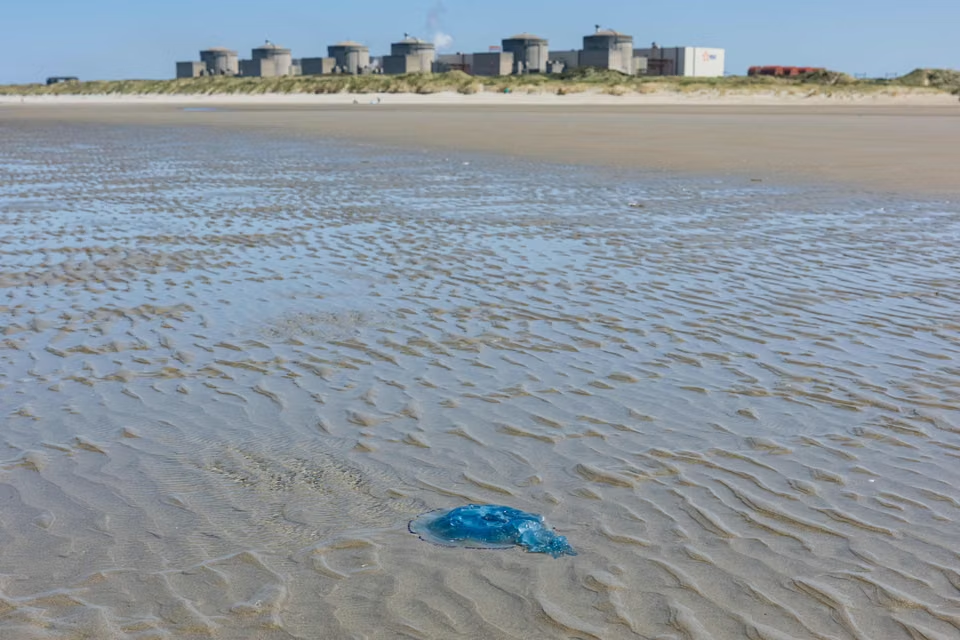
Add the jellyfish to the heat and the low rivers and the arithmetic gets embarrassing. On 12 August 2026, 20.4 per cent of France's nuclear generating capacity was unavailable, the worst environment-related figure in the decade EDF has been publishing the data.33 One fifth of the fleet that every nuclear advocate points to as proof the model works, taken out by hot weather, shallow rivers and gelatinous invertebrates.
So the pattern is this. The hotter and drier it gets, the less nuclear power you have. And the moment you have least of it is precisely the moment a few hundred million Europeans reach for air conditioning. Nor is this a freak year to be waved away: the French Court of Auditors has already run the numbers and expects low-water shutdowns to become three to four times more frequent by 2050.34 That is the “new” climate these reactors will spend the rest of their working lives in.
Meanwhile, out in the same endless sunshine, the solar panels were having the best fortnight of their lives, and the batteries were soaking up cheap midday surplus and selling it back at seven in the evening when everyone got home. There is a certain grim comedy in it. The technology we are told we must have because it works when the weather does not stops working when the weather turns, and the ‘intermittent’ renewables the nuclear bros sneer at is still delivering electrons in the time of greatest need. A drought does not care how much baseload you paid for.
There is a final twist here, and it is the one the Green Libertarian enjoys most. The country whose reactors have just been defeated by a river happens to be the most solar-powered country on earth. Hungary drew about 27 per cent of its electricity from solar panels in 2025, a larger share than any other country, having put up more than nine gigawatts of them in barely a decade.35 So while Paks sat there at 170 megawatts, less than a tenth of its normal output, Hungarian solar was running at 4,063 megawatts at midday on 5 August: about twenty-four times what the nuclear plant was managing, and more than three quarters of everything the country was consuming at that moment.36
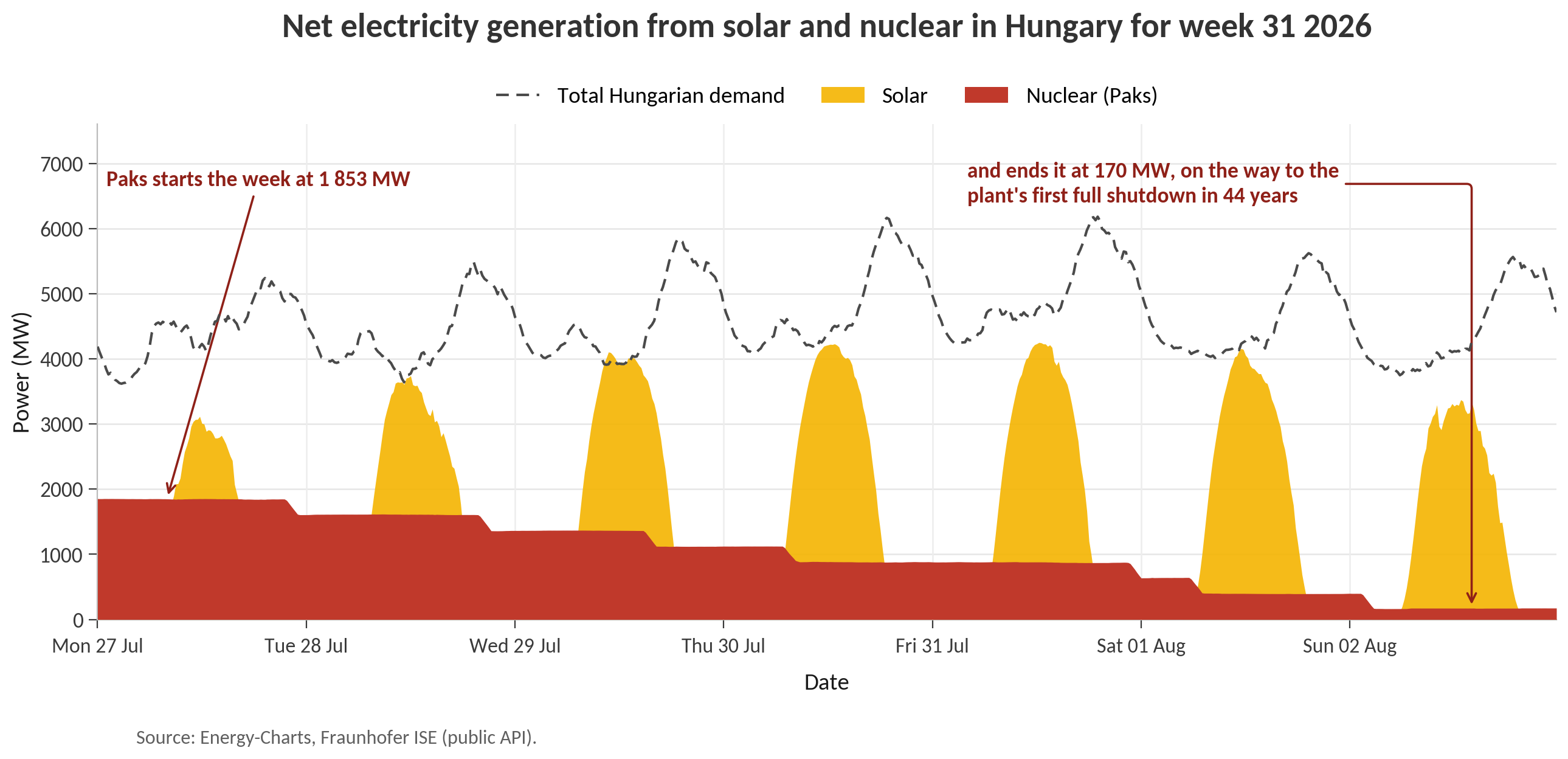
Honesty compels a caveat, because the Green Libertarian does not do cheerleading either. This does not mean Hungary sailed serenely through. The country is under a declared energy emergency, it has been importing expensively after dark, it has leaned hard on fossil gas in the evenings, and its largest industrial users have been asked to cut consumption. Solar softened the blow; it did not absorb it. But look at what the government actually reached for when the reactors went down: an emergency widening of grid access for household solar panels, because panels are the only generation you can add in weeks rather than decades. Paks II, the Russian-built answer to all of this, is due some time in the mid-2030s. The ‘intermittent’ technology the bros sneer at was the one still standing when the ‘reliable’ one ran out of river.
Sovereignty runs on electrons, not enriched uranium
Finally, there is the pesky business of energy sovereignty – the ability of a country to rely on its own sources of electricity. Regular readers know the Green Libertarian cares about the unglamorous business of a country being able to keep its own lights on without asking permission from outside forces. It is worth pausing here, because nuclear’s sovereignty pitch may be its most oversold feature of all.
Hungary has just demonstrated as much, twice over. First, a country that draws half its electricity from a single plant discovered, in the space of a week, that the plant answers to the river rather than to the government. Second, and better still, consider Hungary’s answer to that problem. Rising beside the reactors that have just gone dark for want of cooling water is Paks II: two new 1,200-megawatt Russian VVER units, on the same stretch of the same shrinking river, built by Rosatom under a contract worth about €12.5 billion, of which up to €10 billion is a loan from the Russian state. First concrete was poured in February 2026. The units were originally meant to be generating by 2026 at the latest and are now spoken of for the mid-2030s. In September 2025 the European Court of Justice annulled the Commission’s approval of the Hungarian state support propping it up, and the incoming government has said it will review the entire arrangement.37 So the plan is to fix a plant that cannot run on a low Danube by building a bigger one next to it, a decade late, with Russian money and a Russian contractor, on the same river. If you can locate the energy sovereignty in that, do write in.
Hinkley Point C, again: French state utility, Chinese state co-investor, British bill-payers. Fermi America: Westinghouse reactors with a tangled American, Japanese and Canadian ownership history, foreign engineering partners, federal fingers in the pie, and a campus named after a sitting president. And the fuel itself is the least sovereign part of all: as recently as 2023, Russia supplied about 27 per cent of the enriched uranium that powered America’s reactors, which is why Washington only got round to banning Russian uranium in 2024, and even then with waivers that run until 2028.38 Trace the supply chain of any large nuclear project and you find enriched uranium, foreign vendors, and decades-long contracts with state-backed firms. Where, may I ask, is the sovereignty?
Now look at the alternative. Spain and Portugal’s solar panels, Denmark’s and Germany’s offshore wind turbines, Germany’s heat pumps. Once installed, these are sovereign assets that make electricity out of sunlight and wind, offshore and over land. No fuel imports. No enrichment contracts. No radioactive waste waiting on a burial plot that does not exist. No strike-price deal with a foreign state utility running until your grandchildren are middle-aged. No exclusion zone. And no gauge on a riverbank that decides, in August, whether the country gets to have electricity. Every year the maths tilts further their way: the fuel is free, the kit keeps getting cheaper, and the storage that firms it up is sliding down the same curve. Sovereignty, it turns out, runs on electrons from the sun and the wind, not on enriched uranium.
Chernobyl showed how Nuclear can dramatically explode; 2026 is proving that it can quietly stop.
40 years on from the Chernobyl disaster, nuclear energy is once again at a crossroads. The meltdown in Ukraine proved that nuclear fission technology was not infallible; 2026 is demonstrating in real time that it is also unreliable in the face of climate change. In the meantime, renewable energy and battery storage keeps getting cheaper. The renewable transition has trade-offs; Nuclear has consequences. The trade-offs can be mitigated through the kind of economic ingenuity the free market is good at, and the worst of a botched clean-energy buildout can be cleaned up within a working lifetime. The aftermath of a nuclear catastrophe cannot. And the blistering summer of 2026 is proving in real-time that the technology sold to us as the cure for the climate crisis is idling on the banks of a shrunken Danube, waiting for rain.
Sources
- Generally attributed to a flawed RBMK reactor design (positive void coefficient) plus a safety test run in violation of procedures. Sources: World Nuclear Association; IAEA.
- Recognised immediate toll: 31. The WHO/IAEA Chernobyl Forum projected up to ~4,000 eventual deaths among the most exposed and up to ~9,000 across the wider region; some studies go far higher. source: WHO/IAEA Chernobyl Forum.
- The 1979 Three Mile Island partial meltdown released little radiation and caused no deaths or detectable public-health harm. source: U.S. Nuclear Regulatory Commission.
- The 11 March 2011 Tohoku earthquake is recorded at magnitude 9.0–9.1. Sources: USGS; Japan Meteorological Agency.
- Energiewende post: insert published URL here.
- China connected its first commercial reactor in 1991 and now runs ~55, with the world's largest new-build programme. Sources: IAEA PRIS; World Nuclear Association.
- France generates the highest share of its electricity from nuclear of any country, ~65 per cent. Sources: IEA; World Nuclear Association.
- The first newly built U.S. reactors in a generation, Vogtle 3 and 4 (Georgia), entered service in July 2023 and April 2024. Sources: U.S. EIA; Georgia Power.
- Vineyard Wind 1 blade failure, 13 July 2024; fibreglass debris on Nantucket beaches; GE Vernova agreed a $10.5m settlement with the town. Sources: WBUR; Utility Dive; Nantucket Current.
- Chernobyl Exclusion Zone ~2,600 km² (later enlarged to ~4,140 km²); half-lives: Cs-137 ~30 yr, Sr-90 ~29 yr, Pu-239 ~24,000 yr. Sources: German BfS; Britannica.
- Hinkley Point C cost ~£35bn (2015 prices) / ~£46–49bn today; Unit 1 power ~2030. Sources: New Civil Engineer; World Nuclear News (2026).
- Infographic by Michael Taylor (sources: EDF, Cour des Comptes, IRENA, NEA/IEA, US DOE EIA): installed cost ~$11,000/kW (2016) to ~$20,000/kW (2024); ~2.5x solar PV, 2.9x offshore wind, 5.5x onshore wind.
- Strike price £92.50/MWh in 2012 money, index-linked, 35 years. source: gov.uk Value-for-Money Assessment.
- CfD Allocation Round 6 (3 Sep 2024): solar £50.07/MWh, onshore wind £50.90/MWh, fixed-bottom offshore ~£58–59/MWh, 15-year terms. source: gov.uk / Hansard; ORE Catapult.
- UK operational grid battery capacity ~1.1 GW (2020) to ~7 GW (end-2025), a record ~4 GWh added in 2025; storage costs down ~93 per cent since 2010. Sources: Energy-Storage.News; IRENA.
- Fermi's Carson County, Texas development is filed as the 'President Donald J. Trump Advanced Energy and Intelligence Campus', reactors as the 'Donald J. Trump Generating Plant'; first reactor targeted ~2031. Sources: ANS Nuclear Newswire; The Register.
- Fermi America IPO ~1 Oct 2025: ~$682m raised at ~$13.8bn; peak >$26 (~$20bn); market cap to ~$3.4bn / shares -78% by 20 Apr 2026; CEO and CFO departed; proxy fight; a tenant pulled $150m, shares -46%. Sources: Haynes Boone; Fortune; DCD; Stocktwits.
- Project Matador: up to 11 GW behind-the-meter from nuclear + solar + six Siemens SGT-800 fossil-gas turbines, financed for 2028 delivery. Sources: Finviz; Barchart.
- Vogtle 3 and 4, Georgia: about $35bn against an original ~$14bn, an overrun of roughly $21bn, and about seven years late; the two units entered service in 2023 and 2024, some 17 years after the initial permits, and main contractor Westinghouse went through Chapter 11 in 2017. Sources: POWER Magazine; U.S. EIA; Associated Press, 'Trump administration announces $17.5 billion in loans for 10 new large nuclear reactors', June 2026.
- U.S. Department of Energy, announced 23 June 2026: up to $17.5bn in conditional loans, about $3.5bn per project, to fund long-lead components for ten 1.1 GW Westinghouse AP1000 reactors, two at each of five sites. Seven utilities signed letters of intent; five sites to be selected, none named at announcement. Utilities and Westinghouse to contribute up to $5bn of equity in total. DOE expects the loans to shorten schedules by up to three years, with construction starting by 2030 and operation in the mid-2030s. source: Associated Press, June 2026; U.S. Department of Energy.
- Travis Fisher, director of energy and environmental policy studies at the Cato Institute, quoted by the Associated Press, June 2026. Energy Secretary Chris Wright's remarks on Vogtle and on taxpayer risk are from the same report.
- NuScale's flagship Utah project was cancelled in November 2023 after its target price rose from $58 to $89/MWh. Sources: E&E News; Utility Dive; IEEFA.
- Solar LCOE fell ~90 per cent and battery storage costs ~93 per cent, 2010–2024. source: IRENA, Renewable Power Generation Costs in 2024.
- Fukushima: ~1.3 million m³ treated water; ALPS release began Aug 2023, ~30 years projected; cleanup estimate ~¥21.5tn (~$141bn). Sources: IAEA; Asahi Shimbun.
- Paks (4 reactors, ~2,000 MW) supplies close to half of Hungary's electricity. Units shut progressively from late July 2026; output ~25 per cent by 1 August; first full shutdown in the plant's 44-year history. Danube gauge at Paks: -134 cm forces full shutdown, forecast to -144 cm, against a previous record low of -98 cm in 2018. Sources: NBC News; Al Jazeera; CNN; Bloomberg (Aug 2026). Peter Magyar's Tisza party defeated Fidesz on 12 April 2026 and he took office as prime minister on 9 May 2026, ending Viktor Orban's 16 years in power. Sources: CNN; Al Jazeera; House of Commons Library.
- Romania: one of two Cernavoda reactors already shut for lack of cooling water; military engineers and divers detonated ~180 kg of explosives at the Parjoaia cliff near Izvoarele to slow the Bala branch and divert flow along the Old Danube toward the plant; 100+ military personnel involved; national energy state of alert declared for August 2026; losing the second reactor would cut national electricity output by ~20 per cent. Sources: Bloomberg; CEENERGYNEWS; The Guardian (3 Aug 2026).
- Nuclearelectrica began a controlled shutdown of Cernavoda unit 2 on 13 August 2026, the first unit having been stopped in late July; the 1,400 MW plant normally supplies about a fifth of Romania's electricity and this is the first drought-driven total shutdown since 2003. Romania budgeted more than EUR 2 million (about $2.3 million) on measures to divert the Danube towards the plant, including blasting a rock that was restricting flow and sinking four rock-laden barges. Plant director Romeo Urjan said he did not expect a restart within ten days. The Ministry of Energy said wind and imports would cover the shortfall, appealed for responsible consumption and warned that large industrial consumers could face evening restrictions as a last resort. Sources: Agence France-Presse; Associated Press; Al Jazeera; Euronews; Bloomberg, August 2026.
- Hungary: Prime Minister Peter Magyar said on 12 August 2026 that the government had ordered the construction of a submerged weir to control flows near Paks, with two 80-metre barges stationed at the plant that can be sunk to raise the water level. Copernicus, the European Union's climate change observatory, found flow rates in nearly two thirds of the Danube at their lowest in over three decades. Sources: Agence France-Presse; Al Jazeera; Copernicus.
- France, ~61 GW installed nuclear: EDF cut ~5.5 GW (~8.7 per cent of capacity) during the June 2026 heatwave and up to ~5.7 GW (~9 per cent) in July as temperatures reached 43°C. Golfech unit 2 (1,300 MW) shut fully on 30 July 2026 as Garonne temperatures rose; Chooz 2 (1,450 MW) and Bugey 3 (900 MW) offline; Saint-Alban (Rhone), Blayais (Gironde) and Tricastin curtailed. Thermal discharge limits are typically 26–28°C. Sources: Montel; Industrial Info; Euronews; SFEN.
- Switzerland: both Beznau reactors were taken off the grid on 26 June 2026 when the Aare reached the 25°C regulatory threshold, then alternated between full shutdown and roughly 50 per cent output. Slovenia: Krško began reducing reactor power to 80 per cent overnight on 6 August 2026 with the Sava at about -298 cm; its environmental permit caps the daily average Sava temperature downstream of the Brežice hydro plant at 28°C and the plant-caused rise at 3°C. Krško also supplies Croatia. Reporting across the episode counted at least ten reactors shut or curtailed across Europe. Sources: France 24; SeeNews; Balkan Green Energy News; Nuclear Engineering International; Power Technology.
- Bulgaria: despite record-low Danube levels, both operating units at Kozloduy remained at planned capacity. A dedicated task force was set up in early July 2026 and the plant draws cooling water through deep intake channels served by 34 high-power pumps. Sources: Kozloduy NPP statements; BTA; Novinite.
- Gravelines, Nord, France, six 900 MW reactors, the largest nuclear power station in western Europe. On the night of 10-11 August 2026 a jellyfish bloom entered the pumping station's seawater intake drums; three reactors shut down automatically and the output of a fourth was halved, with a fifth unit already off line for maintenance, taking roughly 3.2 GW off the grid. EDF stated there was no impact on the safety of the installations, staff or the environment. The same plant was shut by a jellyfish bloom in August 2025. Sources: EDF statement; Le Monde; Agence France-Presse; South China Morning Post.
- On 12 August 2026, 20.4 per cent of France's nuclear generating capacity was unavailable, combining reactors off line or de-rated for low river flow and high water temperature with the Gravelines jellyfish shutdowns. Calculated by Agence France-Presse from the availability data EDF has published since 2015. Sources: Agence France-Presse; EDF.
- The Cour des comptes has projected that low-water-driven reactor shutdowns in France will become three to four times more frequent by 2050. source: Cour des comptes.
- Hungary had the highest share of solar power in its electricity mix of any country in 2025, at roughly 27 to 28 per cent, with more than 9 GW installed. Sources: Ember; Clean Energy Wire; CEENERGYNEWS.
- Energy-Charts (Fraunhofer ISE) public API, public_power, Hungary, 5 August 2026: solar peaked at 4,063 MW at 12:00 CEST, against nuclear output of about 170 MW and total load of 5,306 MW at that moment. The renewable share of Hungarian demand peaked at about 82 per cent. Emergency measures reported the same week included a temporary widening of grid access for household solar and voluntary industrial demand reduction.
- Paks II: two VVER-1200 units (1,200 MW each), Rosatom as main contractor, contract value ~EUR 12.5bn, financed by a Russian state loan of up to EUR 10bn plus ~EUR 2.5bn from the Hungarian budget. First concrete poured for unit 5 in February 2026; original plans envisaged commercial operation by 2026, now discussed for the mid-2030s. In September 2025 the Court of Justice of the European Union annulled the European Commission's approval of Hungary's state support; the incoming government has said it will review the project's financing and implementation. Sources: World Nuclear Association; Balkan Green Energy News; Interfax; CJEU.
- Russia supplied ~27 per cent of the enriched uranium used by U.S. reactors as recently as 2023; the Prohibiting Russian Uranium Imports Act (May 2024) bans imports, with waivers declining to 1 Jan 2028. Sources: U.S. NRC; U.S. DOE; Congress.gov.